Deep Fryer Inspection
A deep fryer, also known as a deep-fat fryer (or frier), is a kitchen appliance used for deep frying. While commonly used in commercial kitchens, smaller household models are now available.
 conductivity and allows the food to be cooked rapidly. Some types of fats heat up slowly, such as olive oil. Corn, sesame and coconut oils are fats that heat up quickly, so they're ideal to use in deep-fat fryers. Frying works by quickly withdrawing the moisture from a food’s surface, which then becomes crispy and limits the food's internal moisture from leaching out during cooking. A successfully deep-fried food will thus be crispy on the outside and tender yet fully cooked on the inside.
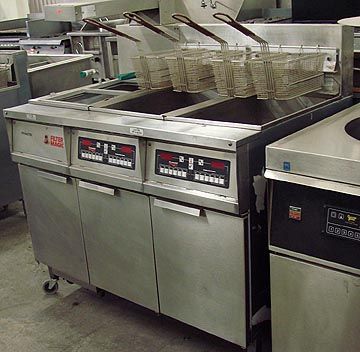
Restaurant fryers are available in a range of designs, from simple countertop units to floor models equipped with multiple oil tanks, casters and filtration systems. Commercial fryers are generally available in mild steel or stainless steel. Mild steel is more likely to corrode and stain. It expands when heated, which may damage its welds over time. Fry baskets also come in various shapes and sizes, from taco salad bowls to onion loaf baskets, and with or without heat-resistant handles.
- Electric fryers are more energy-efficient than gas fryers because their heating elements are immersed in the oil, and they have a faster temperature recovery time between frying cycles.
- Gas fryers heat up more quickly and to a higher cooking temperature than electric fryers. Gas fryers can be powered by either natural gas or propane, both of which are generally less expensive energy sources than electricity.

Commercial deep fryers generally contain all or a combination of the following design features:
- a basket to lower the food into the oil tank and raise it when the food has finished cooking;
- timers and alarms;
- automatic devices to raise and lower the basket into and out of the oil;
- ventilation systems to exhaust frying odors from the kitchen;
- an oil filtration system or chemical treatment to extend the usable life of the oil; and
- mechanical or electronic temperature controls that save energy and prevent fires by continuously sensing and adjusting the temperature of the oil.
Fire Safety Inspection for Commercial Deep Fryers
- A Class K fire extinguisher should be kept near the deep fryer. These extinguishers emit a fine mist of potassium acetate and are the only type of extinguisher appropriate for grease fires because they will not cause the oil to splash onto other surfaces. The extinguisher should be clearly marked with information detailing its appropriate use. Keep in mind that fire extinguishers expire and must be periodically inspected, the instructions for which can be found in InterNACHI’s article on Fire Extinguisher Maintenance and Inspection.
- An overhead fire-suppression system that is specifically designed for commercial kitchens can help extinguish dangerous grease fires. Confirm that the fire-suppression nozzles line up directly over each deep fryer and cooking appliance.
In addition, inspectors can check for the following defective conditions that increase the likelihood of a grease fire:
- Unnecessary objects stored above the fryer may fall into the fryer. Even a small amount of hot oil splashed onto the skin can cause permanent injury, and any liquid spilled, such as that from a cup of soda, can cause a lethal explosion.

- The oil level is too high or too low. Markers should indicate acceptable oil levels. Insufficient oil is a fire hazard because it will quickly become overheated, while excess oil can spill from the unit when French fry baskets or other items are lowered into the fryer.
- The oil is too hot. The vapors from overheated cooking oil can ignite. Keep sources of open flame away from the deep fryer and ensure that safety features are installed and functional. A safety cut-out switch may be installed to prevent the oil from overheating.
InterNACHI commercial inspectors and restaurant operators may also check for the following unsafe conditions:
- Older equipment may lack modern safety features, such as an exhaust system, built-in grease filters, a grease disposal system, or vat covers.
- Slip-resistant flooring around the fryer may be absent or insufficient for the area. More than 3 million employees are injured every year as a result of slips and falls in restaurants, and these accidents are the greatest source of general liability claims in the restaurant industry, according to the National Fire Safety Institute. Even customers are put at risk when grease is tracked into the dining area. Much of this danger can be mitigated by installing and maintaining high-traction, slip-resistant rubber mats around the fryer according to the following measures:
- The mats should not rise higher than ½-inch over the surrounding floor, as this poses a trip hazard.
- The mats should not be buckled or curled.
- The mats should be firmly affixed to the floor to prevent migration, and the underlying floor should be clean and dry.
- Electrical cords present a trip hazard. In addition to injuries caused by tripping on the cord, smaller fryers are vulnerable to tipping over if someone trips on the cord and spills the deadly contents onto those nearby.
- Copper, black iron or brass used for the fryer or any of its parts is not recommended, according to the Centers for Disease Control (CDC). These metals accelerate the deterioration of cooking oil. Look for baskets made from these metals in older fryers, and recommend replacement with stainless steel or aluminum types.
- Deep fryers using the same oil for multiple fryings should be sifted for items such as old food or uninvited guests. As reported by CBS, Chicago health inspectors temporarily shut down a restaurant when they found a dead rat in the deep fryer trap.
Inspectors may also pass along the following maintenance and usage tips to the restaurant owner/manager:
- Prior to operating the fryer, review the operations manual provided by the manufacturer. Follow all recommendations on proper installation and maintenance of deep frying equipment.
- Between uses, lower the temperature of the fryer to 250° F (120° C). When the kitchen is closed, turn the fryer off and cover it with a metal lid, as recommended by the CDC.
- Do not salt or season food over the deep fryer. As with copper, brass and iron, salt deteriorates cooking oil.
- Take down, clean and degrease the baffle filters in the hood to reduce grease buildup and the risk of fire.
- Hire a professional cleaning contractor to clean the exhaust duct and flue above the fryer. Make sure the fryer hood and surrounding areas are free from grease.
- Do not put any foods into the fryer that have ice crystals. Ice, like water, reacts explosively with hot oil. While deep-fried ice cream is a popular treat on the carnival circuit, it is made with a coating that completely envelopes the frozen ice cream and fried for only about 15 seconds to avoid explosion.
- Frying oil should be changed when the level of its total polar materials (or polar content) is greater than 24%, which can be measured with a handheld device or commercial test kit. In the absence of these instruments, the oil should be changed when it darkens, smells rancid, froths, or pours thickly. Old oil will also not fry foods adequately and increases the levels of unhealthy oxidized lipids and acrylomides. Note that deep fryer oil, unlike brown grease retained by grease traps, can be recycled. “Yellow grease,” as it is called, can be used later to feed livestock, as well as to make soap, makeup, clothes, rubber, detergents, and bio-diesel fuel.
- Store unused fryer oil in a cool, dark place, as light and heat will degrade the oil's quality.
- Frequently remove food particles and crumbs from the deep fryer.
- Deep fryers washed with soap should be rinsed with a diluted vinegar solution to neutralize any remaining soap.
- Never move hot oil. Allow it to cool completely before handling.
Turkey Fryers
A turkey fryer is a cooking appliance used to deep fry turkeys. A longtime favorite in the Deep South of the U.S., and rising in popularity elsewhere, these domestic fryers significantly reduce the time required to cook the bird when compared with a conventional oven or rotisserie grill.  Traditionally, the turkey fryer consists of a large pot with a lid, a drain valve, a burner, and a basket or other device to hold and raise the turkey. The propane tank that powers the unit must be purchased separately. Stainless steel parts are included on high-end units, while aluminum pots are common in inexpensive fryers. Some units also include a temperature control valve that automatically adjusts the oil's temperature by sensing its temperature and adjusting the amount of propane allowed to enter the burner.
- Oil can overflow when the turkey is submerged, dripping into the burner and causing the entire unit to explode. Many homes have been destroyed in this fashion, as the flames are hot enough to incinerate their surroundings. One UL representative even likened a turkey fryer that had caught fire to “a vertical flamethrower.”
- Tipovers are inherent to the design. Unlike commercial fryers that have a low center of gravity and substantial weight, turkey fryers are lighter, vertically-oriented units that can be easily knocked over, spilling hot, flammable grease. In March 2010, according to the UK-based Daily Mail, a young British girl succumbed to injuries caused by grease burns when she knocked over a turkey fryer.

- Operators of turkey fryers are typically not trained in deep frying safety and, as such, overlook safety considerations that are routine in restaurant kitchens.
- The sides of the cooking pot, lid and pot handles get dangerously hot, posing severe burn hazards.
To reduce the likelihood of these and other concerns, InterNACHI inspectors can pass along the following safety tips to their residential clients:
- Always measure the amount of oil needed and never overfill the pot. The safest way to accomplish this is to place the turkey in the empty pot and fill it with oil until the turkey is slightly submerged. Remove the turkey and heat the oil, but turn the burner off before slowly lowering the turkey into the oil. Turn the burner back on after the turkey has been fully lowered.
- Never use a turkey fryer indoors, except for electrical units designed specifically for indoor use. In November 2009, a Nebraska man successfully fried a turkey in his garage, but even after he turned the unit off, the heat had nowhere to go. It rose to the attic where it caused items to smolder, igniting a fire that soon caused the nitrous oxide tank in the man's car to detonate. Damages were estimated at $250,000, according to the McCook Daily Gazette. This incident also illustrates the next warning.
- Never use a turkey fryer near anything that might explode or catch on fire. It should also never be used beneath a tree or fence, or on a wooden deck.
- Center the pot over the burner on the cooker before using the fryer.
- Raise and lower the turkey slowly to reduce splatter and avoid burns, and cover bare skin when removing or adding food.
- Never use a turkey fryer on an uneven surface. Even a grass lawn or gravel patio can have uneven dips that cause the fryer to sink or tip. Also, mitigate potential tipping hazards by choosing a sturdy fryer with a low center of gravity.
- Consider using an electric turkey fryer. They don’t heat up as fast, but they can be used indoors and they’re generally safer than propane-powered models.
- Completely thaw the turkey and make sure it's dry before putting it into the fryer. A wet or frozen turkey, for the aforementioned reasons, will cause the oil to quickly boil over and potentially explode like a bomb. According to the U.S. Department of Agriculture, turkeys require 24 hours of thawing for every 4 to 5 pounds.
- Monitor the oil temperature. Oil will ignite if overheated, and most home turkey fryers have no thermostat controls. If the oil begins to smoke, immediately turn the gas off. If it ignites, call 911.
- Attend the fryer at all times, and keep children and pets a safe distance away.
- Make sure you have a Class K fire extinguisher nearby.

