Wat is Efflorescence?
Efflorescence is a type of discoloration. It is a deposit, usually white in color that occasionally develops on the surface of concrete, often just after a structure is completed. Although unattractive, efflorescence is usually harmless. In rare cases excessive efflorescence, within the pores of the material, can cause expansion that may disrupt the surface.
Efflorescence is caused by a combination of circumstances: soluble salts in the material, moisture to dissolve the salts, and vapor transmission or hydrostatic pressure that moves the solution toward the surface. Water in moist, hardened concrete dissolves soluble salts. This salt-water solution migrates to the surface by vapor transmission or hydraulic pressure where the water evaporates, leaving the salt deposit at the surface. Particularly temperature, humidity and wind affect efflorescence. In the summer, even after long periods of rain, moisture evaporates so quickly that comparatively small amounts of salt are brought to the surface.
Moisture testing to determine the vapor pressure at the slab surface will tell you how much moisture is moving through the slab. A common value of vapor pressure acceptable for moisture sensitive floor coverings is 3 to 5 lb./1000 sq.ft./24 hours. The Calcium Chloride Vapor Pressure Test is commonly used. Testing of the soils and concrete would identify the source of the soluble salts. and a look at the drainage, irrigation systems, accommodation of the building runoff (downspout drops etc.), and ground waters may give some valuable clues as to the source of moisture that is driving this process
These types of problems can be very complex to resolve. One possible strategy would be to install a French drain system which over time will lower the moisture content of the soil under the slab. With lower moisture content under the slab, the transmission of water through the slab will slow or nearly cease. Without the moisture the salts are no longer transported to the slab surface and the process should stop. Avoid adding additional water to the system. In general any wet process cleanup converts the buildup to a solution which is re-deposited onto the concrete surface to reappear when the concrete dries. In many cases the use of a dry method cleanup will help to reduce or prevent a re-occurrence of efflorescence
Efflorescence!
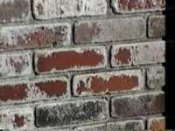
(This information applies to efflorescence on all surface types,
including brick, block, tile, grout, slate, stone, concrete work, pavers, limestone, marble, granite, etc.)
Where it comes from! – How to remove it! – How to stop it!
Where does it come from?
Two conditions must be present to create efflorescence:
- A source of water soluble salts.
- Water moving through the material to carry the salts to the surface. The water evaporates and leaves the white powder behind.
Some surfacing products are more prone to have efflorescence because:
- They might be more permeable and promote water travel.
- They might tend to have higher water soluble salts in some batches.
Despite the best efforts of surfacing manufacturers to minimize water soluble salts in their products, they use materials from the earth that can vary from batch to batch.
The causes and treatments of efflorescence are the same, regardless of the material on which it appears. Flooring, roofing, walls and their component materials only vary in the product application technique, as described on product labeling.
Water sources can be:
- IN/OUT - Entering at the surface (rain or sprinklers), penetrating in a fraction of an inch, then returning to the surface carrying the salts.
- THROUGH - Entering from behind (bad flashing, caulking, leaks) or underneath (water from the earth migrating up) and traveling through.
There are two kinds of efflorescence.
- Regular “powdery” efflorescence as described above and is still gone after “Efflorescence Treatment” dries.
-
"Crystalline" efflorescence. When powdery efflorescence goes through cycles of being deposited on the surface - re dissolved when new water occurs - drying out - new water - etc. it can form crystals. The crystals become tightly bonded to the surface. The crystals do not have to be thick. A light haze that is still there after using “Efflorescence Treatment” will be light crystal formation and is treated as described below.
These white stains and blooms are all efflorescence.
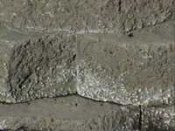

This is a worst case efflorescence condition. And - this is the interior wall! The extensive blooming was caused by long term, heavy water intrusion from bad flashing. The wall is the interior wall of “double wythe” construction. This is where two brick walls separated by an air gap serve as one structural wall. Within the air gap is a supply of water soluble salts that has lasted for years. Rainwater has been flowing into the wall gap and carrying salts out for a long time.
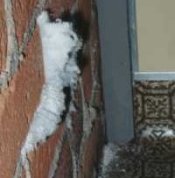
This may help. Marcel 


