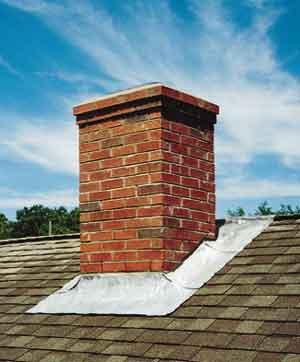
This does not look right to me. Shouldn’t there be some sort of counter flashing, maybe a step flashing grouted in to the mortar joints? This flashing flares out at the top and is just filled with different types of sealant. It kinda looks like upside down drip edge.
I think in some cases were the surface is smoother, it is acceptable to not have a counter flashing, but to depend on mechanically fastening the flashing and using sealant. But up against coarse brick with deep mortar joints, I think a step flashing is necessary. Am I wrong?
Did the one below recently on a house that had just been re-roofed.
I pointed it out to the client that caulk was being relied on to prevent leaking and that it should be monitored regulary. It appeared to be a good grade of butly caulk which is very tough stuff. Not the way I would want it done.
Sure you can; however, if that is aluminum siding material or a piece of metal roofing material, there will not be any metal flashing under the shingles. It looks like it is sitting on top and caulked.
Step flashing should have been used or it could have been counter-flashed with a saw-cut into the masory and sealed. That’s how they do it in my town. It looks better than step and seals better IMO.
Hi Wesley…What everyone says about the flashing is correct.
Unfortunatly if you come to chicago you will find it is done this way all the time.
My own roof was done this way as the roofing contractors cover up the old flashing rather than tearing it off.Common practice ,Yes, is it Right No.
They keep the price low doing it that way and the municipalities do not seem to have a problem with it.So check the books it is a write up.
Check with a lot of roofers and it is considered ok.
Michael, it looks like they applied the flashing on top of the shingles and then caulked the edge of the flashing where it ended at the shingles. :shock: :roll:
That’s what see too. It was a decent roof job except for that. I assume it also caulked where the shingle meets the brick but that of course is hidden.
Quote:
The chimney appears to be improperly flashed. I have never seen it done like this before. The material they used looks like upside down drip edge. See where the top edge of the flashing tilts out and away from the chimney. This is just begging for water to run between the flashing and the chimney, and down into the roof structure, ceiling, and wall. You can see the different colors of sealants used. I suspect that this has been a problem area in the past. Maybe why there is water damage at the ceiling above the fireplace. The proper way to flash a chimney is to install a base flashing that goes beneath the shingles on the sides and back of the chimney and bends up on the vertical walls of the chimney. Step flashings are then recessed into the chimney at the the mortar joints and bend down over the base flashing. The step flashing is sealed at the mortar joints. Its actually more complex than I make it sound. They are called step flashings because they look like steps as they follow the mortar joints going down the roof.
Here is a link; http://service.govdelivery.com/docs/STPAUL/STPAUL_DeptLIEP/STPAUL_270/STPAUL_270_20051013_en.pdf
With this method of flashing, I would expect regular maintenance to be necessary.
End Quote:
I expect to get calls from my client and both agents on this one!!!
that’s poor execution of an unacceptable detail. although counter flashing is sometimes surface applied and sealant applied, this is not a suitable application. and since the installer doesn’t care about what is plainly visible display of his work, i’d question what what hidden – underlayment, overnailing, crooked nailing, missing nails. the top view of the shingles may lay pretty, but pretty isn’t going to keep the weather out or keep them on in high winds. bad form.
Andy, good point, Bob, if you guys get a couple grand to flash a chimney, I’ll be moving my company out your way!!!
The proper way to flash a chimney on a re roof is to take a 4" grinder, grind out the mortar in the courses of the brick and install new lead flashing and reseal, not a big deal!!!
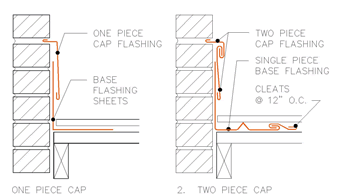
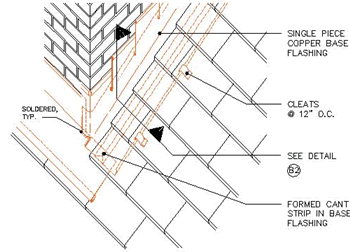
B. Alternate Step Flashing Methods These sections illustrate two methods of stepped flashing. The one on the left uses individual copper base flashing sheets, and a one-piece cap. The other one uses the single piece base flashing with a two-piece cap flashing. Note the hooked edge on the base flashing to prevent water from running under the roofing material. The water is conducted instead to the end of the base flashing, over the apron, and onto the roof below.
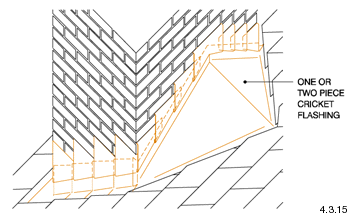
D. Chimney Cricket Flashing This detail illustrates the use of a cricket to divert water above the chimney to either side. The cricket can be a one piece design or a two piece, joined by a standing seam at its ridge.
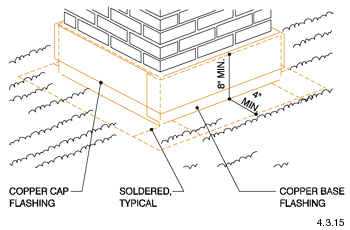
E. Chimney Flashing – Flat Roof Copper base flashing is attached to the roof deck before installation of the roofing. It extends at least 8" up the wall and at least 4" onto the roof, on all sides of the chimney. Copper cap flashing then covers the upper edge. All joints between base flashing sheets are soldered.
When I inspected this chimney, I did not see any indication that this chimney was ever flashed correctly. No evidence of grooves in the mortar joints where a cap flashing was inset. House was built in 1985, roof replaced in 2004 after the hurricanes. I wonder how it was flashed before the roof job.