International Association of Certified Home Inspectors
|
|||||||
| Inspection Education & Training This is a general forum for inspectors to discuss their educational experience, and to ask questions of InterNACHI's Education Committee. This forum is dedicated to the memory of InterNACHI member and educator Gerry Beaumont. Gerry was an avid proponent of education for inspectors and will be sorely missed. |
![]() |
|
|
LinkBack | Thread Tools |
|
#1
|
||||
|
||||
|
This thread is dedicated exclusively for those students currently enrolled in the InterNACHI course titled, "Structural Issues for Home Inspectors" located at http://www.nachi.org/25standardscourse.htm.
Students are free to pose questions and comments here and join in the conversation with other students. The thread will be monitored by the course program manager. Contact: Director of Education, Ben Gromicko ben@internachi.org Thank you. |
| Need a home inspection in Alaska? Check out InterNACHI's listing of Alaska certified home inspectors. Or, find a home inspector anywhere in the world with our inspection search engine. |
|
#2
|
|||
|
|||
|
Hello, I am taking this course right now and I have a question regarding the information from this page:
http://education.nachi.org/show.php?...5&course_id=54 (standard 7 Emergency Egress) In the section about window wells, it says "If the emergency escape and rescue opening has a sill height below ground level, a window well should be provided. The window well should have a horizontal area of at least 9 square feet, with a minimum horizontal projection and width of 36 inches (with the exception of a ladder encroachment into the required dimension)." Assuming that the well is semicircular, a well with a a 36" wide window (and thus diameter) would have a horizontal area of: (pi * (36/2)^2) /2 square inches which is about 510 sq inches Translated into square feet, that's 510/144 = 3.5 square feet. But I see that the second part of the standard says that the "minimum horizontal projection" of 36 inches. So does that mean that semicircular wells are NOT standard (unless you have a well that is about 7 feet wide)? And when we say that it is not standard, then how is it documented on an inspection? Whose standard is being violated? Is this a new rule? I ask because I don't know of any homes in my area that have wells with 9sf, but I know a lot of homes with window wells because of below grade basements. Thanks for your help! Hank |
|
#3
|
||||
|
||||
|
Quote:
R310.2 Window wells. The minimum horizontal area of the window well shall be 9 square feet (0.9 m2), with a minimum horizontal projection and width of 36 inches (914 mm). The area of the window well shall allow the emergency escape and rescue opening to be fully opened. Exception: The ladder or steps required by Section R310.2.1 shall be permitted to encroach a maximum of 6 inches (152 mm) into the required dimensions of the window well. Christopher Currins Certified, Licensed Proudly serving the St.Louis Metro St. Charles, St. Peters, Maryland Heights, O'Fallon, Florrisant, MO Home Inspector BLESSED ARE THE CRACKED, FOR THEY ARE THE ONES WHO LET IN THE "LIGHT"!
|
|
#4
|
||||
|
||||
|
Provocative title.
Will bookmark for later this weekend. |
|
#5
|
|||
|
|||
|
Quote:
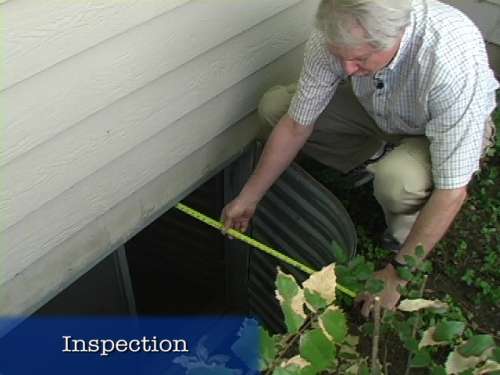
So therefore a window well that is 36" wide, has an 18" projection (hence a semicircular window well) is in violation. But of whose standard? That's what I want to know. I guess what I'm looking for is when I document that this is in violation of the 9 square foot rule, then I'd like to be able to back that statement up with an authority from where it stems, because most of the homes in my neighborhood have wells that look like this: http://education.nachi.org/coursemed...es/egress9.jpg In that picture, you can see the inspector measuring the projection of the window well even though it's pretty clear that there's no way that thing encloses 9 square feet. Is it part of fire safety code or something? I understand the reasoning behind the 9 square foot rule. Because of the large number of local violations, however, I'd like to be able to back that rule up with some authority that I can direct homeowners to, if such a thing exists. Thanks for your help so far! |
|
#6
|
||||
|
||||
|
Hank,
Typically, in a home inspection report, you will not be referring to specific "codes" as we are not code inspectors. A typical report would state "...To current safety standards" or "...Current building standards", or "...Accepted building practices" etc... If and when someone questions the validity of your reporting of the deficiency, then you may refer to Chris's statement above which is from the IRC (R310.2). Jeffrey R. Jonas Critical Eye Property Inspections JRJ Consultants Owatonna, Minnesota Chapter President InterNachi Awards Portal: http://co.nachi.org/inachiawards/
Last edited by jjonas; 7/30/11 at 2:33 PM.. |
|
#7
|
||||
|
||||
|
Christopher Currins Certified, Licensed Proudly serving the St.Louis Metro St. Charles, St. Peters, Maryland Heights, O'Fallon, Florrisant, MO Home Inspector BLESSED ARE THE CRACKED, FOR THEY ARE THE ONES WHO LET IN THE "LIGHT"!
|
|
#8
|
|||
|
|||
|
Thank you guys! I appreciate the prompt and helpful responses you gave me
|
|
#9
|
|||
|
|||
|
I am not understanding the question about window wells. Can you please explain.
|
|
#10
|
|||
|
|||
|
My question was about the square footage recommendations for a window well. It states that for emergency egress from a basement, a window well (which is necessary for a window below grade) must extend a minimum of 36 inches from the window (projection) and the window must be at least 36" wide. This would give a 3 x 3 = 9 square foot area.
However, most wells in my area are window wells that are semicircular with a 36" diameter of the circle. As testament to the prevalence of these wells, our local home depot stocks these: http://www.homedepot.com/webapp/wcs/...01&R=202081201 The description is this: The 19 in. x 44 in. Plastic Window Well Cover is a heavy-duty cover manufactured from plastic. It helps keep your window well clean by keeping out rain, snow, small animals and debris. The easy-to-install cover is designed to fit window wells of 40 in. or less in length and 16 in. or less in projection from the house. The cover adds to the energy efficiency of your basement and allows light to enter your basement window. If you do the calculations, you can see that 40 x 16 = 640 square inches, and 640/144 = 4.4 square feet, which is half of the standard allowance. HOWEVER... (and I just found this out because I read it incorrectly before) This rule applies to basements THAT HAVE SLEEPING AREAS. As the standards course states (and I overlooked): "Where basements have one or more sleeping room, an emergency egress and rescue opening should be installed for each sleeping room, but is not required in adjoining areas of the basement." I take this to mean that basements that are not used for sleeping have no requirements on window well sizes, and/or window sizes. So for all of the below-grade windows that are prevalent around here (and many are made out of glass block, which is considered masonry), the 9 square foot rule of the window wells is something that should be noted if the homeowner intends to use the basement as residential quarters, and that's how I'll document it. Would this language be appropriate in a report? "Basement windows are hopper-style enclosed by glass block, and measure 6" x 12". The windows can not be used for emergency egress. The galvanized steel window well projects 18" and is 36" at the window. Both the window and the area of this well is below accepted standards for safe emergency egress. If the basement is to be used as a sleeping quarters, then a window should be installed that meets the following requirements: + 5.7 square feet in area, with a minimum width of 20 inches and minimum height of 24 inches + No higher than 44 inches from the ground + Well with 9 square feet in area |
![]() |
| Thread Tools | |
|
|
Similar Threads
|
||||
| Thread | Thread Starter | Forum | Replies | Last Post |
| Liability question | jcahill | Legislation, Licensing & Legal Issues for Inspectors | 30 | 8/24/08 4:10 PM |
| Difficult Chimneys | thance | Inspecting HVAC Systems | 2 | 1/29/08 8:16 PM |
| A Mission to Change the Standards - Let's Debate | krichardson | Miscellaneous Discussion for Inspectors | 74 | 12/19/07 8:29 PM |
| Texas Warranty Inspection Standards | badair | General Inspection Discussion | 5 | 9/30/06 5:12 PM |