Roofing Underlayment Types
- asphalt-saturated felt;
- rubberized asphalt; and
- non-bitumen synthetic.
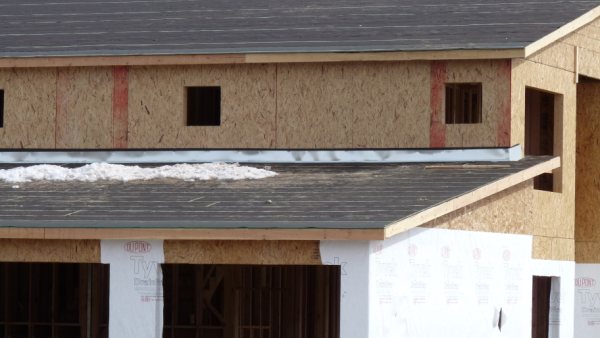


Felt may also be attached in high-wind areas using plastic caps. Plastic caps offer better wind resistance than staples, and help prevent leakage through the holes made by the fasteners.
Edge Metal Laps
Felt underlayment should overlap the edge metal at the eaves and be overlapped by edge metal on the rakes. This is also the case for rubberized asphalt underlayment, but not necessarily for synthetics.
FELT UNDERLAYMENT FAILURE
Asphalt-saturated felt may fail for a number of reasons:
Many manufacturers produce asphalt-saturated paper labeled “Underlayment,” “15-lb.” or “30-lb.,” which do not comply with any standards, and which are often saturated to a lower level than an ASTM-compliant underlayment. These underlayments typically absorb water more readily, and fail sooner. Water absorption can cause wrinkling as the product expands. These wrinkles may telegraph through to roof-covering products, such as thinner asphalt shingles.
Water from the felt may be absorbed by the roof deck, which can cause problems with expansion and contraction of the deck.
When the roof-covering material is being installed, the underlayment takes a beating and may be damaged by footfall or other materials.
RUBBERIZED ASPHALT
Various types of rubber-like materials are also used as underlayment and are generally referred to as “rubberized asphalt.” These typically have adhesive on one side, which is protected by a peel-off membrane, making them self-adhering. The rubber-like qualities of these underlayments make them self-sealing, meaning that they seal well around fasteners, such as staples and nails.
Rubberized asphalt underlayments are manufactured to meet different requirements:
- They may have polyethylene or polyester bonded to the upper surface to provide non-skid and weather-resistant qualities.
- They may have a polymer film bonded to the weather surface to improve moisture resistance.
- They may be fiberglass-reinforced.
- They may have a mineral coating on the weather surface.
They may be formulated for use in high-temperature situations. Some underlayments are designed to resist heat up to 250° F without degradation of the adhesive. This allows them to be installed under metal roofs an in harsh environments.
The asphalt may be polymer-modified.
Polymer-Modified Bitumen
The terms "modified bitumen" is often used when referring to asphaltic roofing materials. Sometimes, this term is shortened to "mod-bit." The term "bitumen" is a generic name applied to various mixtures of hydrocarbons. One of these mixtures is the asphalt used in underlayment, asphalt shingles, and built-up roofing. It's a common term in the roofing industry.
To improve various characteristics such as strength and elasticity, bitumen is sometimes modified using polymers which give it plastic-like or rubber-like properties, depending on which process is used.
Polymers are materials made of molecules which are custom-designed to give the material specific properties. Polymers are used in many different types of roofing products to increase their resistance to damage and deterioration.
Selvedge Edge
Rolls of rubberized asphalt underlayment may come with a selvedge edge along one side of the roll. The selvedge edge is designed to create a strong, watertight seal along the edges where rolls overlap. The selvedge edge should always be along the top edge when the underlayment is installed in courses across a roof.

NON-BITUMEN SYNTHETICS
Advantages
Like other underlayment materials, the use of synthetics has both advantages and disadvantages.
Among their advantages include their light weight and high strength. They are also typically non-skid.
Synthetics are resistant to fungal growth and are wrinkle-free, since they don’t absorb moisture. Although they can be designed as moisture-permeable, they are typically considered moisture barriers.
They’re also very resistant to UV damage and can be left exposed to weather for periods from six months to a year, depending on the manufacturer’s recommendations.
Disadvantages
As of 2010, there are some concerns with synthetic underlayment. According to the National Roofing Contractors Association:
- To date, there are no applicable ASTM standards for these products.
- Many synthetic underlayments don’t meet current building code requirements
- Use of these underlayments may void some manufacturers' material warranties for certain roof coverings (such as asphalt shingles).
- Wicking can be more of a problem than with felt underlayment. Installation along the roof eave is different with some types of synthetics.
- If the installer fails to read and follow the manufacture’s installation instructions and instead installs it like they would if they were using felt, they may create moisture problems.
Slope Limitations
Slope limitations will vary by manufacturer. Some specify a greater overlap for low-slope roofs, and some don’t.
Roof Edges
To avoid problems from wicking moisture, many synthetic underlayments are designed to wrap around the roof edge and protect the edges of the roof sheathing. The edge metal is installed over the underlayment at both the eaves and rakes.
Fastening

