Inspecting Joist-to-Stud Alignment in Wood-Framed Construction
by Nick Gromicko and Ben Gromicko
Home inspectors frequently encounter questions about joist-to-stud alignment during structural evaluations. While traditional construction practice often emphasized perfect alignment, modern building codes recognize that proper load transfer can occur through well-designed double top plate systems. Understanding these code provisions enables inspectors to accurately assess structural compliance and educate clients about contemporary framing practices.
Understanding Double Top Plates as Structural Beams

Double top plates in wood-frame construction function as continuous beams spanning between studs, capable of distributing concentrated loads from joists, trusses, and rafters across multiple support points. This engineering principle allows for flexibility in framing alignment while maintaining structural integrity.
IRC Section R602.3.3: The Code Requirements
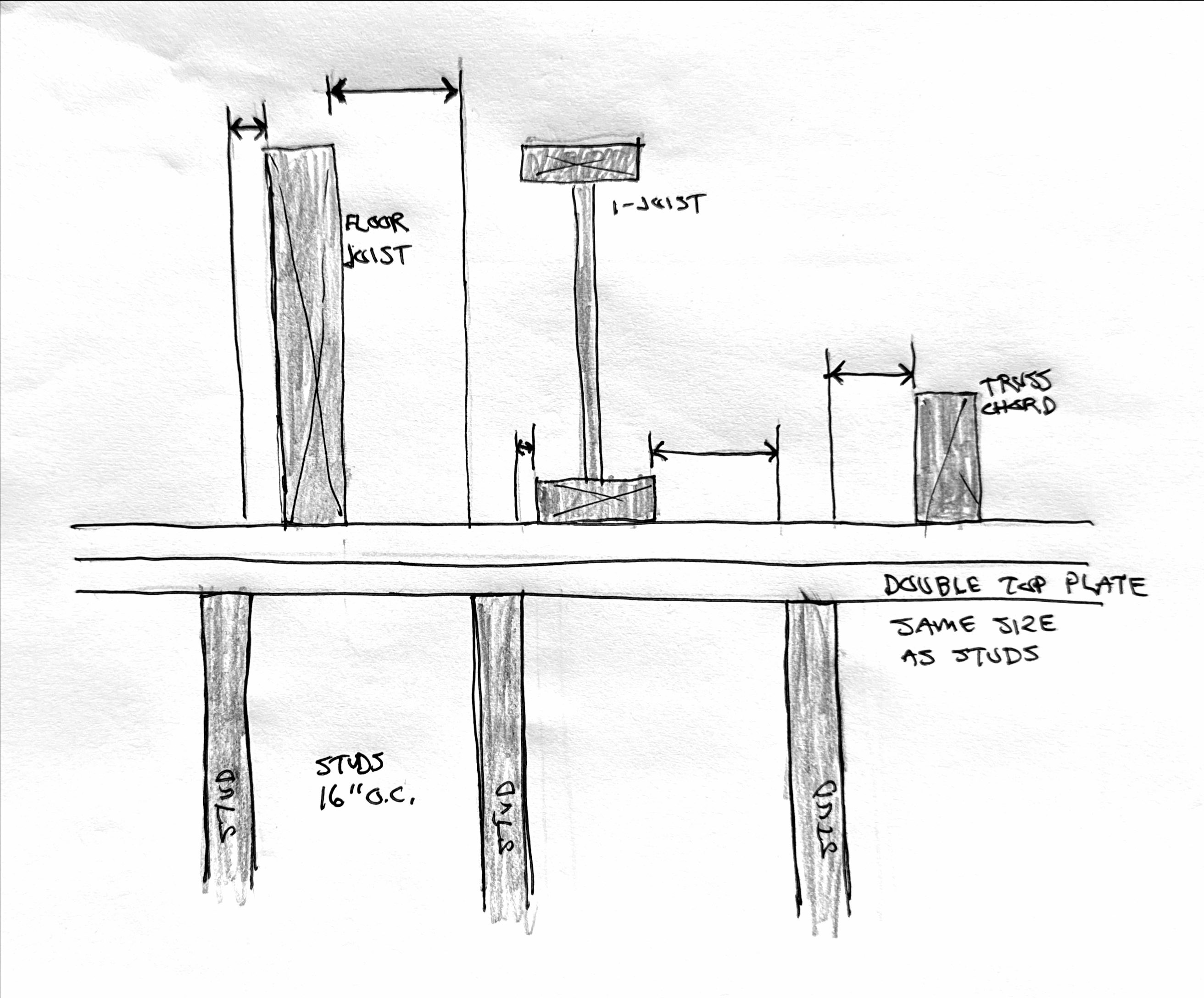
A common stud wall framing is shown above. The 2"x4" studs are 16" o.c. and the double top plate is the same size as the studs. The roof rafters, floor joists, or truss chords are resting on the double top plate, and the studs are at 16 inches (406 mm) on center. In this situation, there are no limitations to the distance between the location of the rafter, joist, or chord on the plate and the location of the wall stud.
- Joist, trusses, or rafters need not align with the bearing studs below spaced 16 inches (406 mm) apart.
5-Inch Rule
When horizontal framing members (joists, trusses, or rafters) exceed 16-inch spacing and bearing studs below are at 24-inch spacing, these framing members must land within 5 inches of the supporting studs. The code provides three alternative compliance methods that eliminate this 5-inch alignment requirement:
- Enhanced top plate sizing: Using two 2×6 or two 3×4 top plate members instead of standard 2×4 plates
- Triple top plate construction: Installing a third top plate member
- Blocking reinforcement: Adding solid blocking equal in size to the studs to reinforce the double top plate system
These alternatives recognize that adequate load transfer can be achieved through enhanced structural capacity rather than strict alignment requirements.
Importantly, when horizontal framing members are spaced at 16 inches or closer, no alignment restrictions apply. The reduced individual loads at this closer spacing can be effectively distributed anywhere along properly constructed double top plates.
Inspection Protocol
- Document spacing: Measure center-to-center distances for both horizontal framing members and bearing studs.
- Examine top plate construction: Verify two properly sized members with staggered joints.
- Check plate continuity: Ensure joints don't align vertically, which compromises structural performance
Load Path Analysis
Trace forces from each joist or rafter through its bearing point on the top plate to the studs below. Pay special attention to concentrated loading areas such as girder trusses, beam pockets, or convergence points where multiple framing members meet.
Common Deficiencies
Top Plate Issues
- Undersized plates relative to stud dimensions
- Improperly staggered or aligned joints
- Inadequate nailing between plate members
- Notching or damage that reduces load capacity
Load Concentration Problems
Multiple loads converging on small top plate areas may require engineering evaluation, particularly where structural irregularities create unusual loading patterns.
Reporting Considerations
When documenting alignment issues, provide clear explanations that help clients understand both structural implications and code compliance. Frame discussions within the IRC's performance-based approach, explaining that perfect alignment isn't always structurally necessary when proper load transfer mechanisms exist.
For conditions exceeding code-permitted tolerances or appearing to compromise structural integrity, recommend consultation with a qualified structural engineer.
Key Takeaways
Modern building codes recognize that effective load transfer can occur without perfect joist-to-stud alignment when:
- Double top plates are properly constructed and sized
- Framing spacing falls within code parameters
- Load distribution capacity isn't exceeded
This nuanced understanding moves inspection beyond simple alignment checks toward comprehensive evaluation of structural load transfer systems, ensuring both code compliance and structural safety.
Summary
Modern code provisions recognize that joist-to-stud alignment requirements depend on framing spacing and load magnitude. When horizontal framing members are spaced at 16 inches or closer, no alignment restrictions apply. For wider spacing scenarios, the code provides specific tolerance limits and alternative compliance methods through enhanced top plate construction. Home inspectors should focus on evaluating the complete load transfer system rather than assuming perfect alignment is always required, enabling more accurate assessments that reflect current engineering understanding and code requirements.
