Inspection Checklist for the Food Waste Disposer
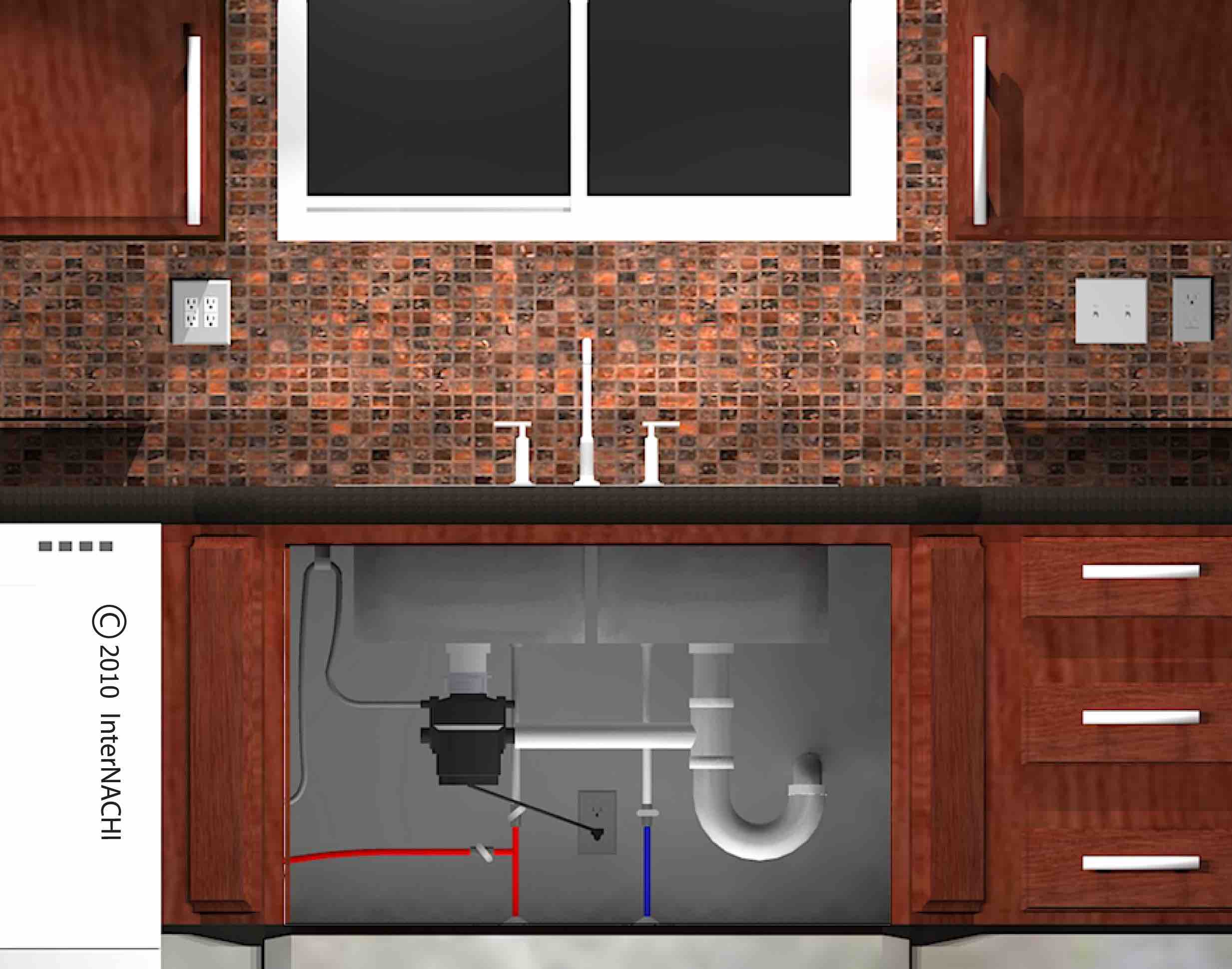
While the Home Inspection Standards of Practice (nachi.org/sop) do not specifically list a food waste disposer as included in a home inspection, inspectors may choose to inspect them.
The following is a checklist for inspecting a food waste disposer in a kitchen to make sure everything is working.
Safety Check
- Before testing how it works, check if it's is getting power. Look for a wall switch or a connection under the sink. If there's no power, check if a ground-fault circuit-interrupter (GFCI) is tripped and reset it—but if it immediately trips again, that's bad. That indicates potential electrical problems.
- NEVER stick your hand inside the disposer unit. Use a flashlight to only look for visible debris.
- If the motor is jammed, that condition requires repair, which is beyond the scope of my inspection.
- Don't disassemble units or remove splash guards during inspection—we're testing operation and identifying visible defects only.
Exterior
- Check the splash guard, which should be intact, flexible, and properly seated in the sink opening.
- Examine the exterior of the disposer for damage, corrosion, and water marks.
- Check for secure mounting. The unit should be firmly attached to the sink and not move when touched.
- Look for indications of water leaks at connections, the bottom of the unit, and discharge pipe joints.
Operation
- Run cold water at the sink, then turn on the disposer.
- Non-functioning units are defects. Be sure to take pictures or video and include them in the inspection report.
- Listen for unusual sounds—grinding, rattling, or metal-on-metal noise indicates problems with the grinding components.
- Feel for excessive vibration, which could indicate some loose mounting or internal damage.
- Turn off the disposer and water.
Drainage
- The discharge tube from the dishwasher (fastened to the underside of the countertop) should connect to the sink waste tailpiece (usually a wye fitting) through an angled tube. Most (if not all) dishwasher manufacturers install the outlet of the discharge pump with a check valve to prevent discharged waste from running back into the dishwasher.
- Waste disposal units (and dishwashers) that are connected to the kitchen sink tailpiece should use a directional-type branch fitting to guide the flow. Options include a tee equipped with a baffle, a wye branch, or a similar type of directional fitting that would direct the flow of discharge. Refer to 2024 IRC P2707.1).
- Disposers must connect to drains not less than 1½ inches (38 mm) in diameter, which is consistent with the size of the waste outlet tubing from a kitchen sink. (Refer to 2024 IRC P2716.1).
- Check the discharge connection to the drain system. It should connect to a wye fitting or directly to the drain pipe. Check that the discharge tube has proper slope for drainage. (Refer to 2024 IRC P2717.2).
Electrical
- Check for a clamp securing the electrical wire to the unit. This prevents strain on electrical connections. Disposers should have a dedicated electrical circuit and proper grounding.
- Flexible cords are permitted for the disposer to allow easy removal or replacement of the unit, but only if the appliance is listed to be cord-and-plug connected. Refer to 2024 IRC E4101.3.
- Type NM cable cannot be directly connected to a garbage disposal unit because the cable would not be protected from damage as is required by code (Refer to 2024 IRC E3802.3.1). Flexible metal conduit and flexible cord are the two most commonly installed wiring methods for garbage disposal units. Flexible cord is ideal, because it makes installation and removal easy. Refer to 2024 IRC E4101.3 Commentary.
- The flexible cord length for the electrically operated in-sink waste disposer is a minimum of 18 inches (457 mm) and a maximum 36 inches (914 mm). Refer to 2024 IRC Table E4101.3.
GFCI
- Receptacles located within 6 feet (1829 mm) of the kitchen sink are required to have ground-fault circuit-interrupter (GFCI) protection. So, if the disposer is cord-and-plug connected at a receptacle near the sink, then GFCI protection is required. Refer to 2024 IRC E3902.8.
- Some building officials apply the code to require GFCI protection for the food waste disposer in the kitchen regardless of how the unit is wired. The 2024 IRC R3902.12 does not list the disposer as an appliance that requires GFCI protection; however, the electrical branch circuits that supply appliances in the kitchen, such as the dishwasher, must have GFCI protection, regardless of whether the appliance is hardwired or cord-and-plug-connected.
- If you see a receptacle inside the kitchen sink cabinet, or virtually anywhere in the kitchen, it must have GFCI protection to help prevent people from getting shocked. You can check the electrical panelboard and look for a breaker that's labeled with the appliance.
Septic
- Is the house on a septic system? Disposers are generally not recommended for homes with private septic systems, because they increase the loading of solids and require more frequent pumping.
Document any indications of observed major defects in the inspection report. Inoperative units, unusual sounds, and water leaks are primary concerns. It's a good idea to inspect the disposer by running only cold water, and never operate the unit without water running. And again, don't stick your hand inside the disposer.
