Nail Fasteners Through Split Wood: Critical Inspection Points for Home Inspectors
by Nick Gromicko CMI® and Ben Gromicko CPI®
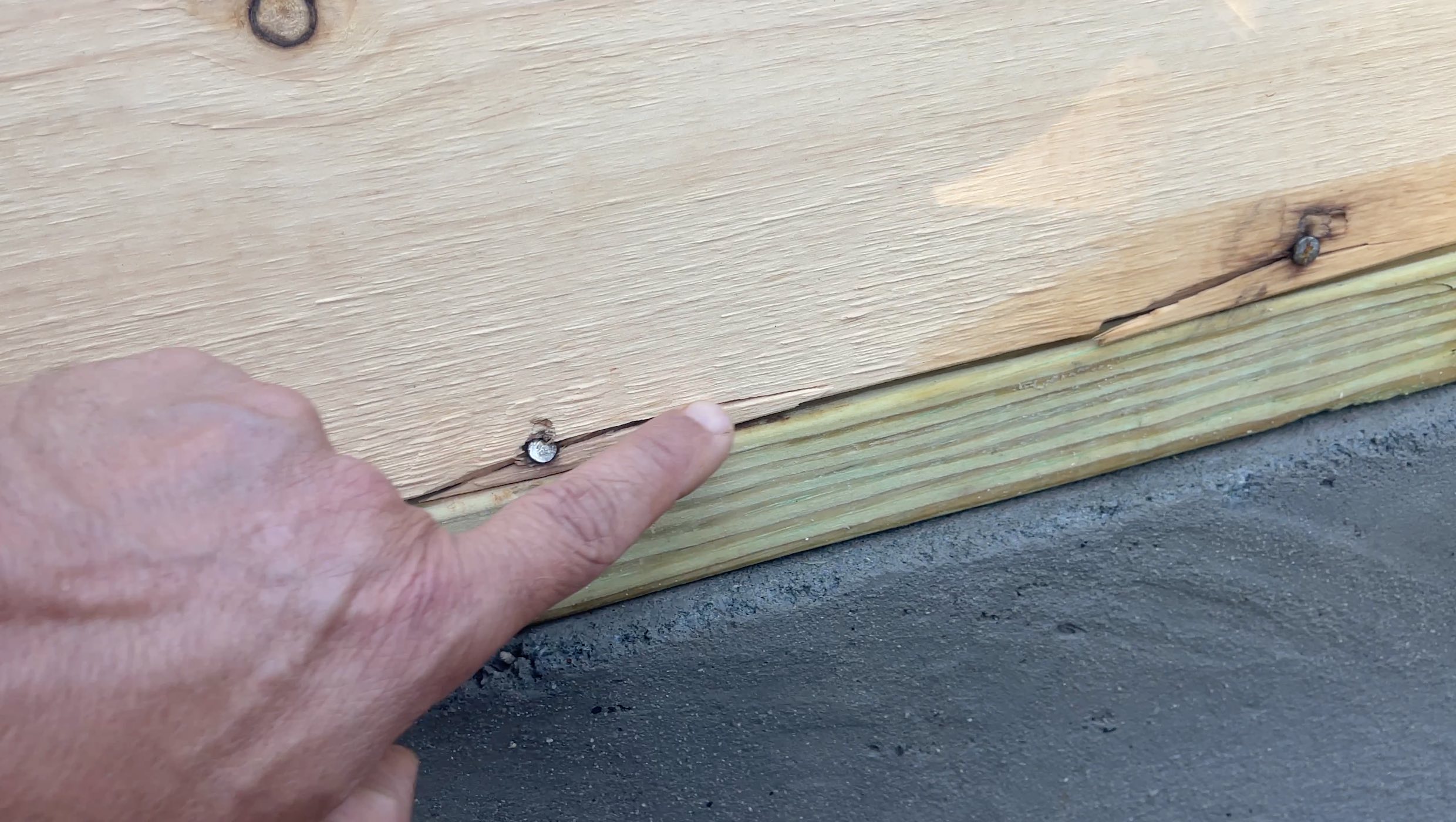
When nails pass through splits in framing wood, their holding power drops dramatically—sometimes by as much as 75%. This a structural problem that home inspectors may observe during an inspection of a home being built, renovated, or repaired. Nails driven through split wood create weak points in the continuous structural load path from roof to foundation.
Join the discussion about this article.
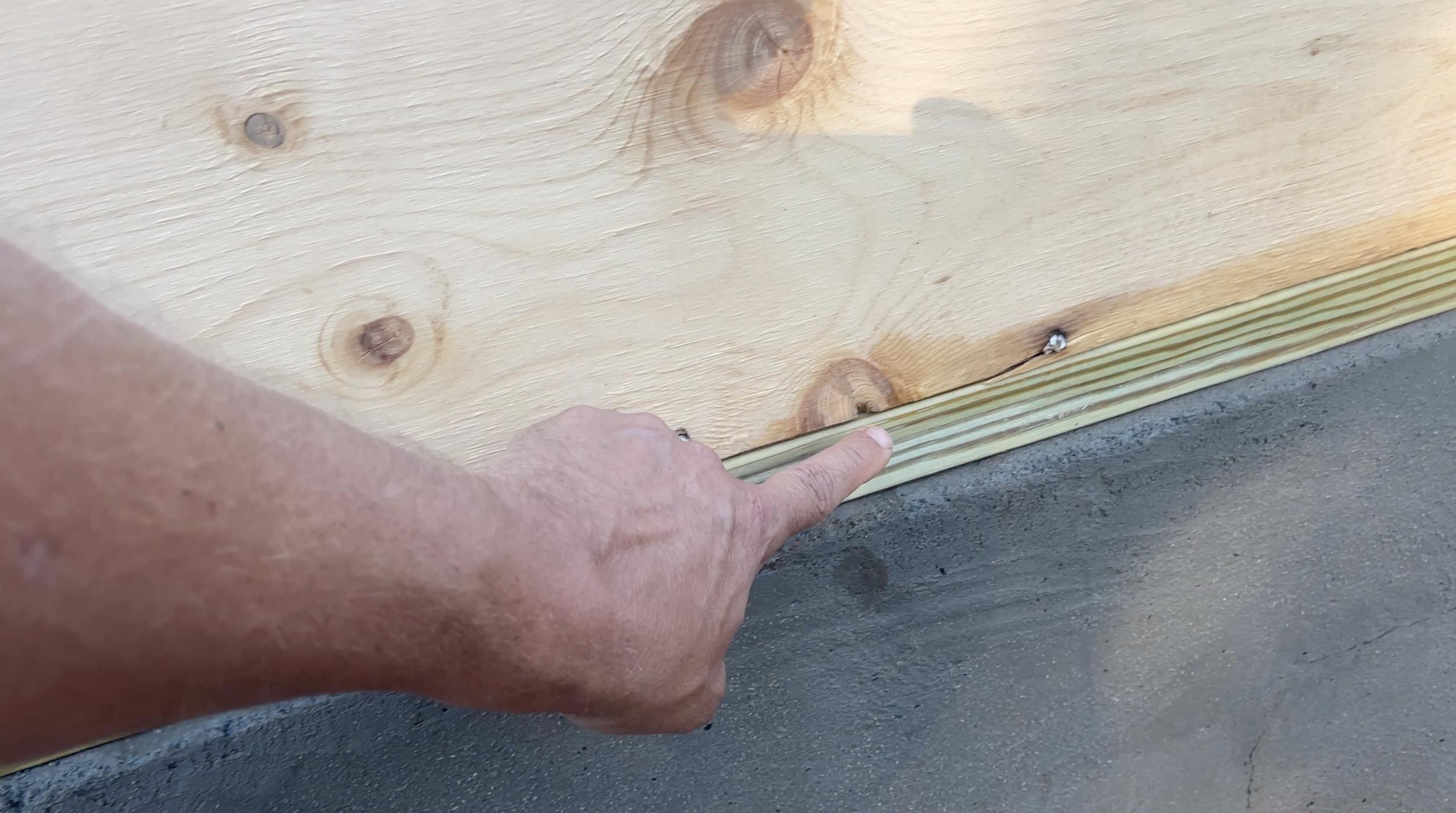
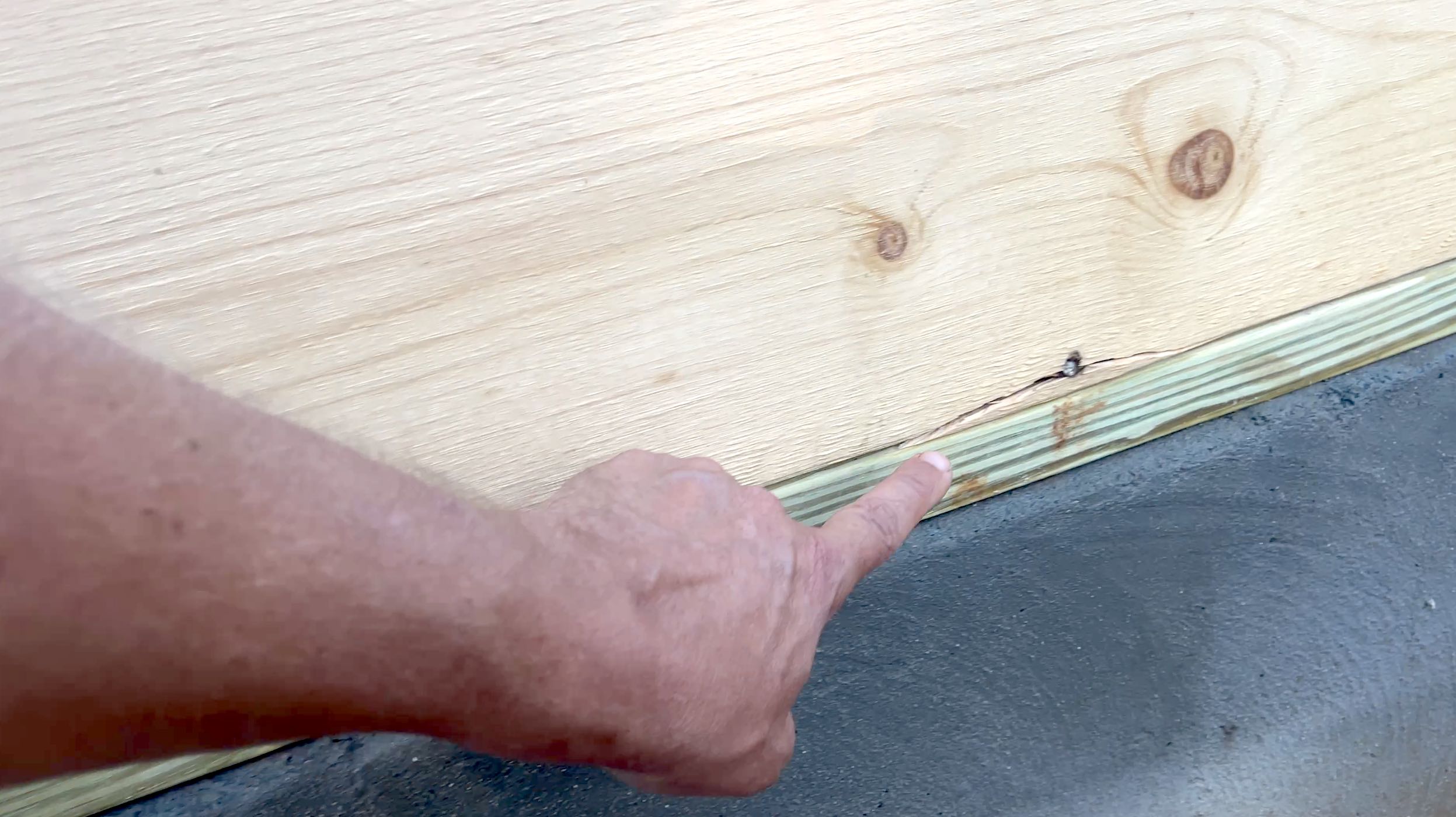
The inspection image shows a home inspector observing fasteners passing through split wood caused by incorrect toenailing of the band joist to the foundation sill plate.
When a nail is installed in a way that splits the wood it's supposed to join, it compromises a home's structural integrity. Instead of the force being transferred effectively through a solid connection, the split wood fibers lose their grip on the nail, dramatically reducing its holding capacity. This creates a weak link in the continuous structural load path—the interconnected framework of a home (from the roof, through the walls, to the foundation) designed to resist and transfer forces from gravity and wind.
Split Wood
Wood fibers work like a bundle of drinking straws packed tightly together. When you drive a nail into solid wood, these fibers compress around the nail shaft, creating friction that holds it in place. Nail-holding power increases dramatically decreases when the wood spits open.
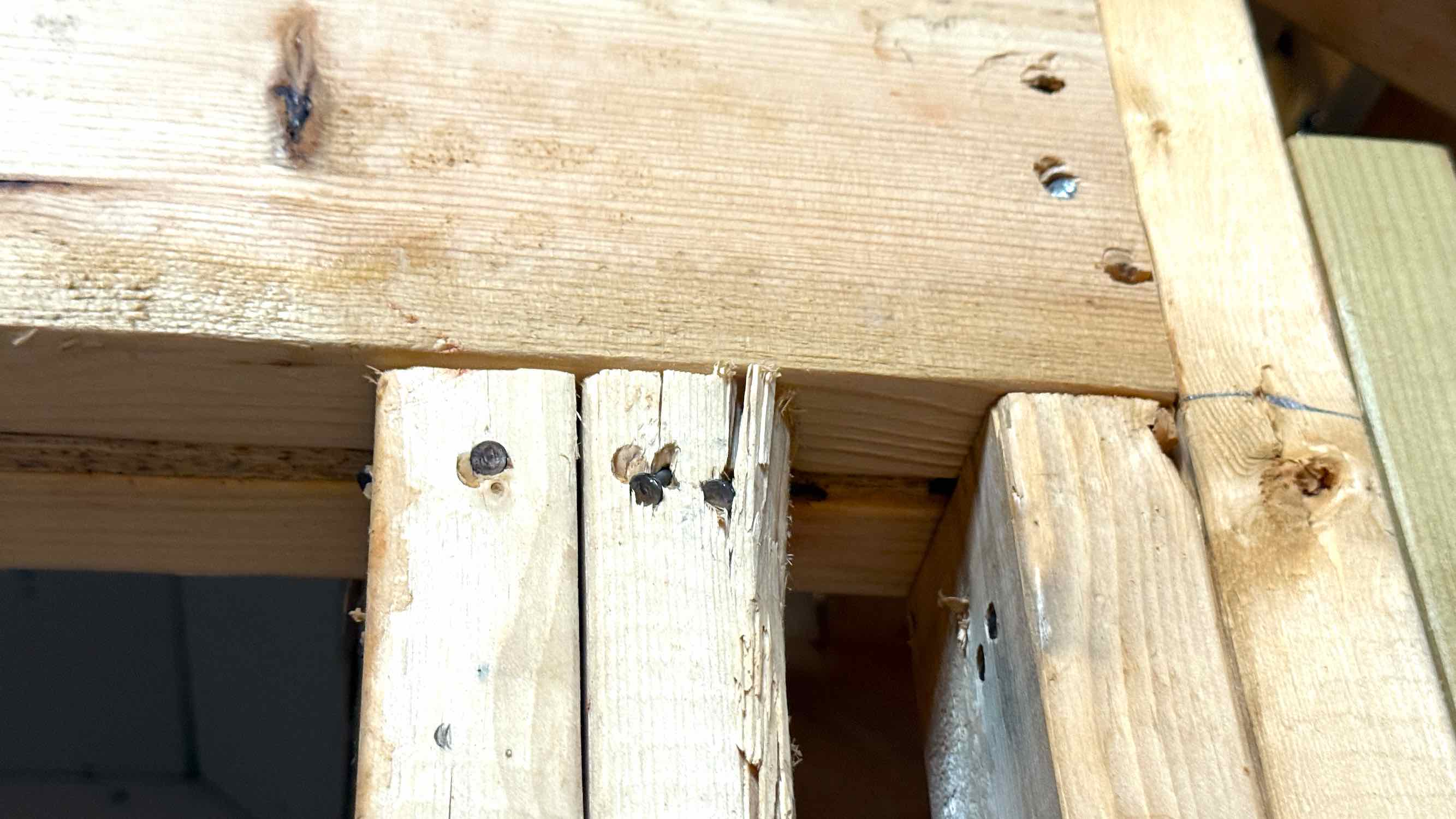
Wood consists of elongated, hollow cells (tracheids and fibers) that are arranged longitudinally. A nail driven into the side grain shears these cells, and the resulting mechanical interlock and friction provide resistance. When a nail is driven into the end grain or when a split occurs, this cellular structure is compromised, reducing the surface area of fiber-to-nail contact and thus weakening the connection.
The inspection image is of toe-nailed fasteners splitting open the end of a 2x4 stud below a door header.
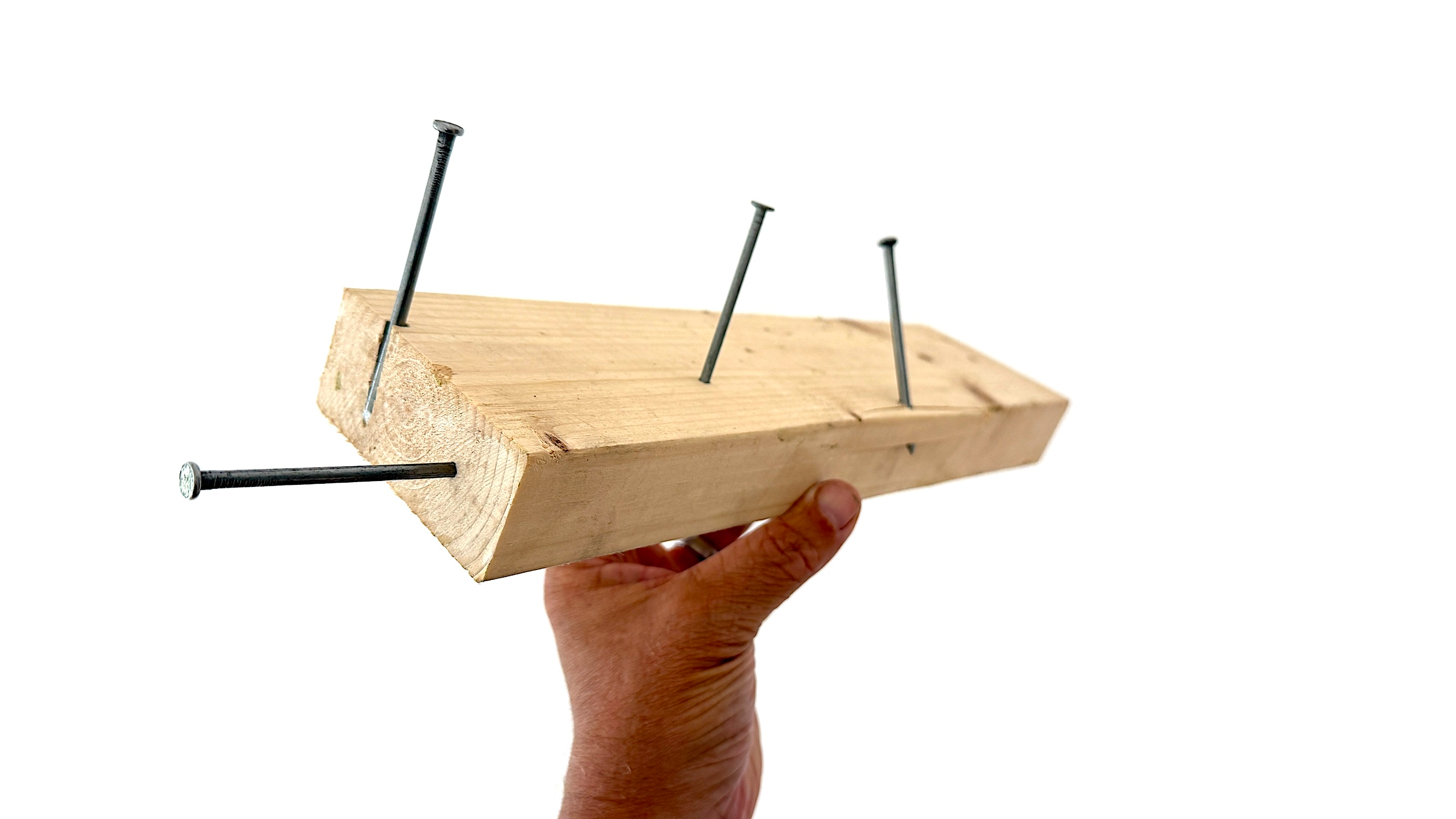
The image shows several 12d common nails driven into a piece of 2x4 wood.
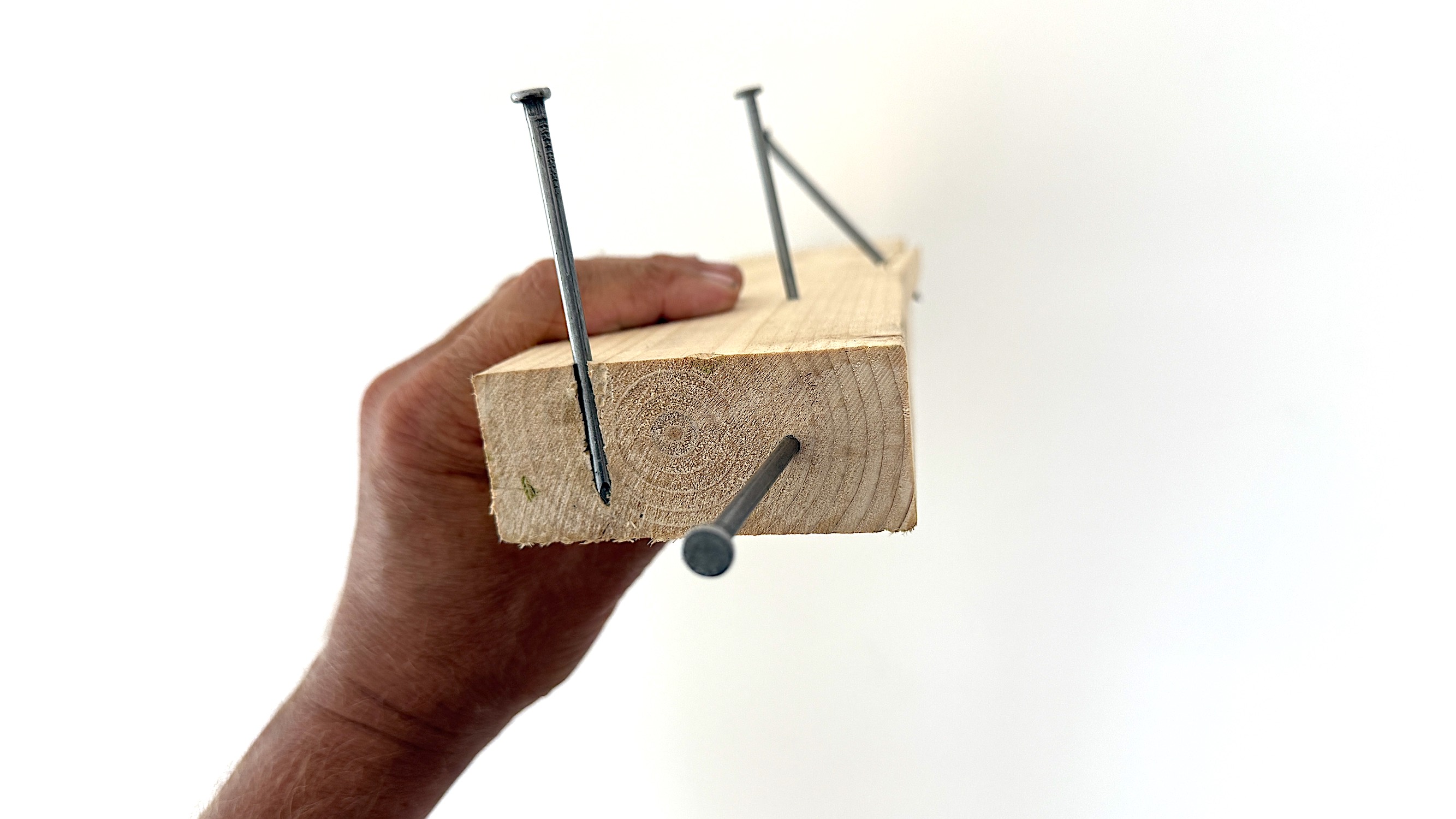
The nail closest to you is driven at the end of the board and parallel with the grain of the wood, which runs down the length of the board. This end nail can be withdrawn easier in comparison to a nail driven on the face of the board, perpendicular to the wood grain.
Nails driven into the end grain of wood (parallel to the fibers) may have only 50-75% of the strength of nails driven into the side grain. End-grain nailing, even in intact wood, has significantly reduced capacity compared to side-grain nailing due to the absence of compressive friction from the perpendicular fibers. When splitting occurs, the capacity is reduced even further. It is a compounding problem, not a separate one.
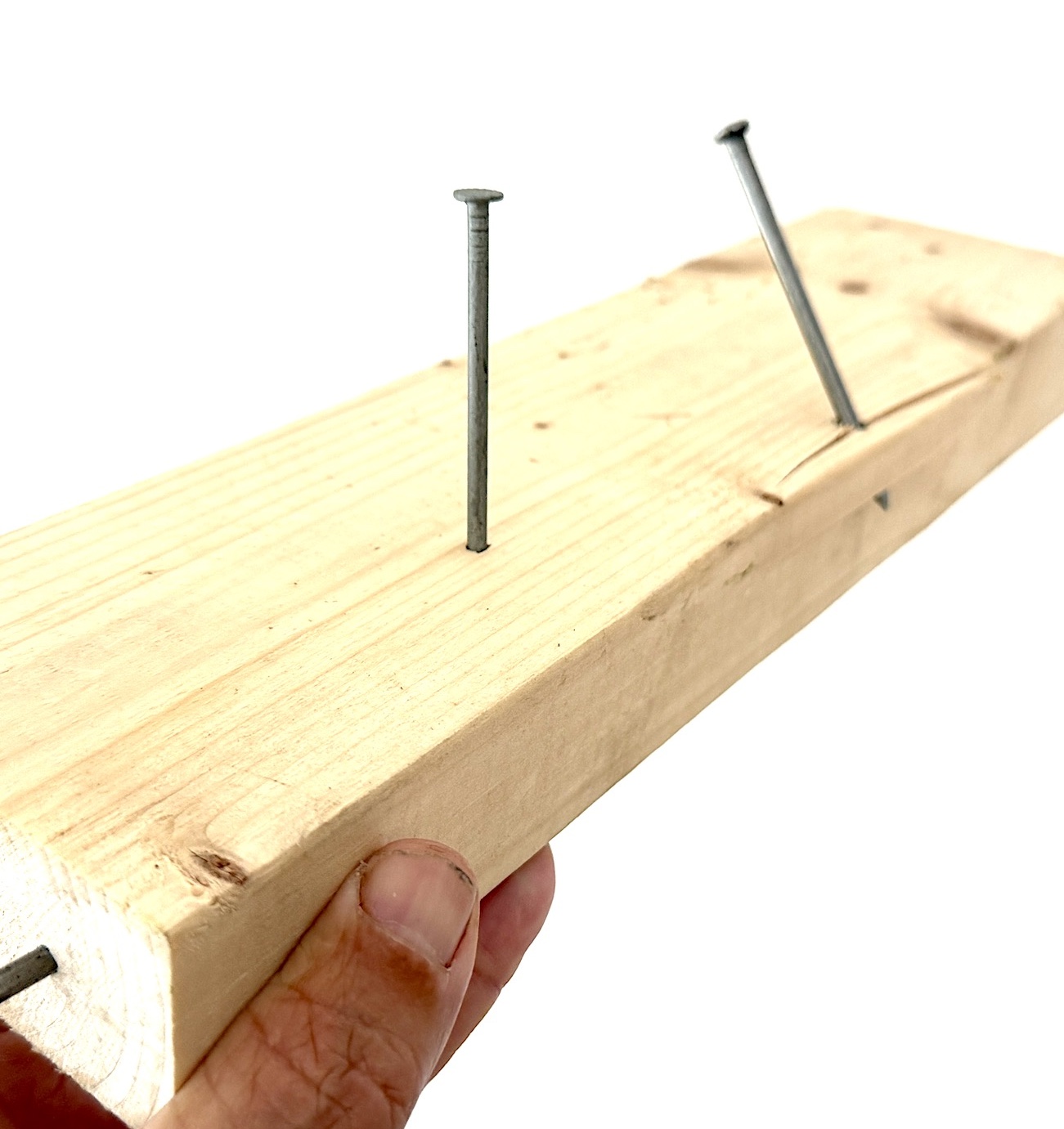
The nail on the side is driven perpendicular to the wood grains providing the greatest holding capacity.
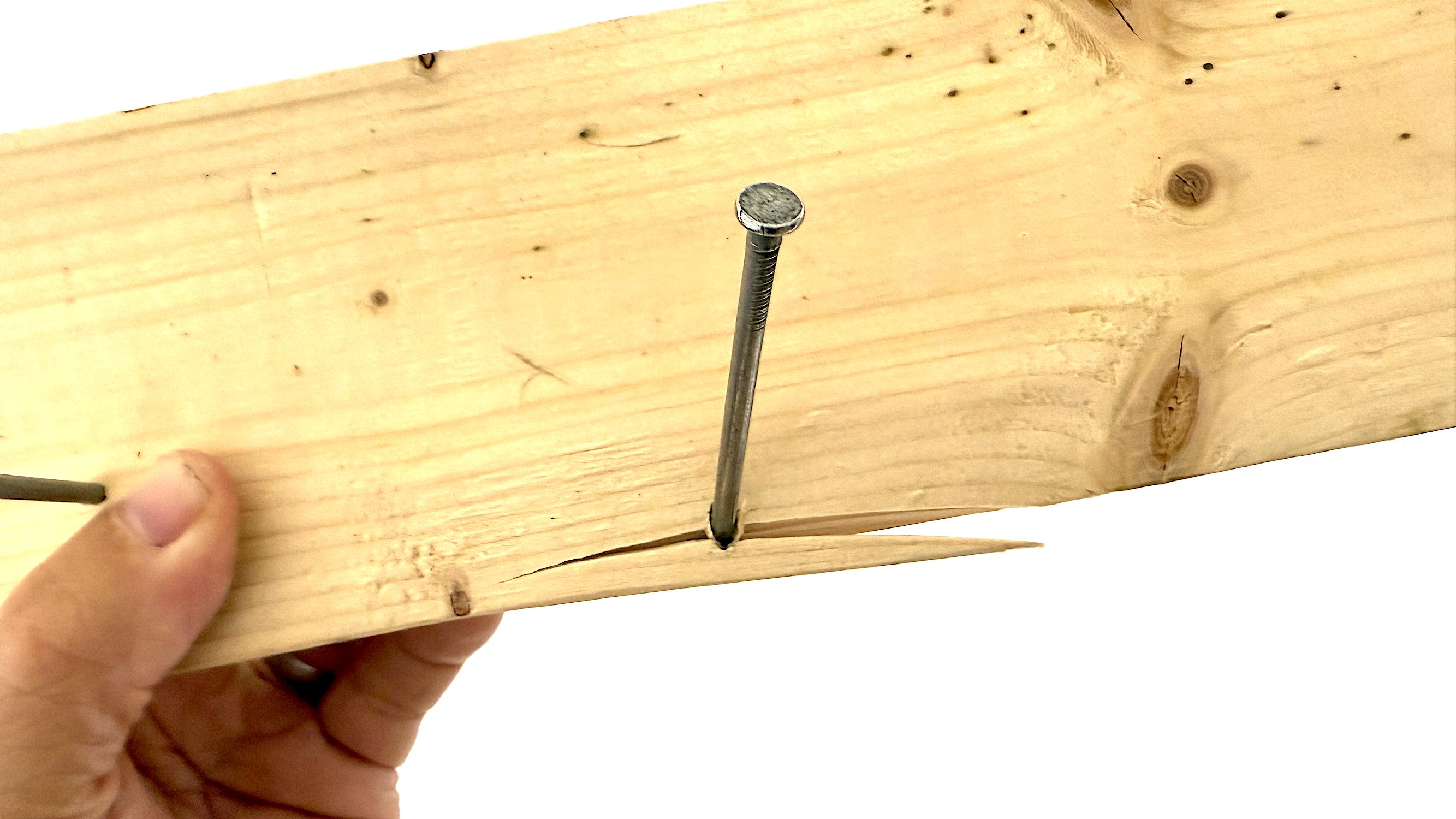
The nail on the right is an improperly toe-nailed fastener that has created a large open split in the wood.
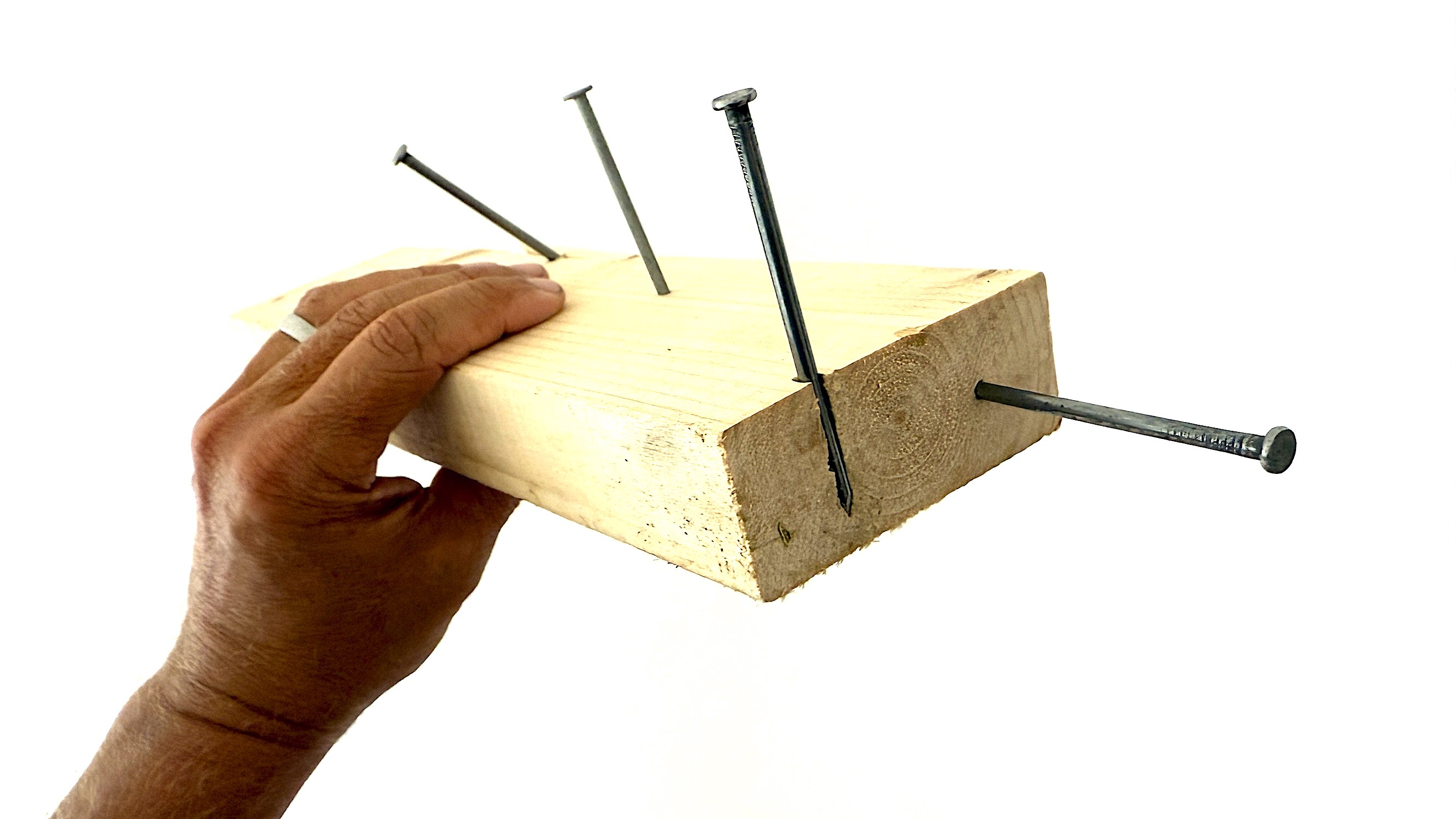
The nail at the very end of the board is driven perpendicular to the wood grain to show how the wood fibers split and crack when the nail is driven into it.
What Happens When Wood Splits
When wood splits, that tight bundle of fibers gets broken apart. Instead of continuous compression around the nail, you get gaps and loose fibers that can't grip properly.
Research shows that nails in split wood can lose up to 75% of their holding capacity.
The inspection image is of a toenailed fastener splitting open an edge of the band joist.
Wood naturally expands and contracts with moisture changes. When nails are driven into green lumber that later dries out, or into seasoned wood that goes through wetting and drying cycles, they can lose a major part of their withdrawal resistance.
What Inspectors Should Look For
Primary concerns:
- Open splits in wood at fastener locations
- Too many nails clustered together, creating stress that causes splitting
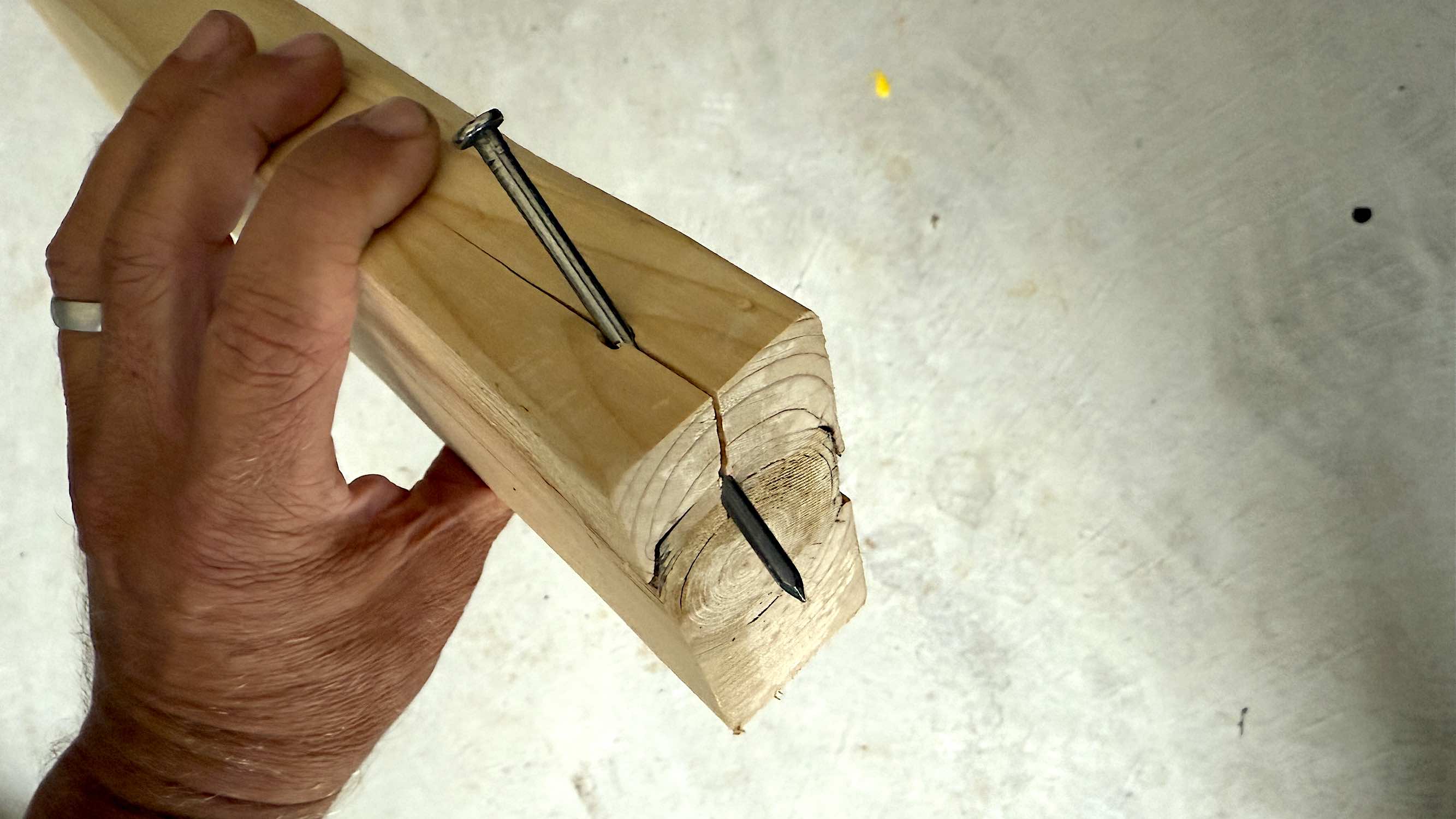
The image of a nail splitting open the end of a 2x4.
Toe Nail
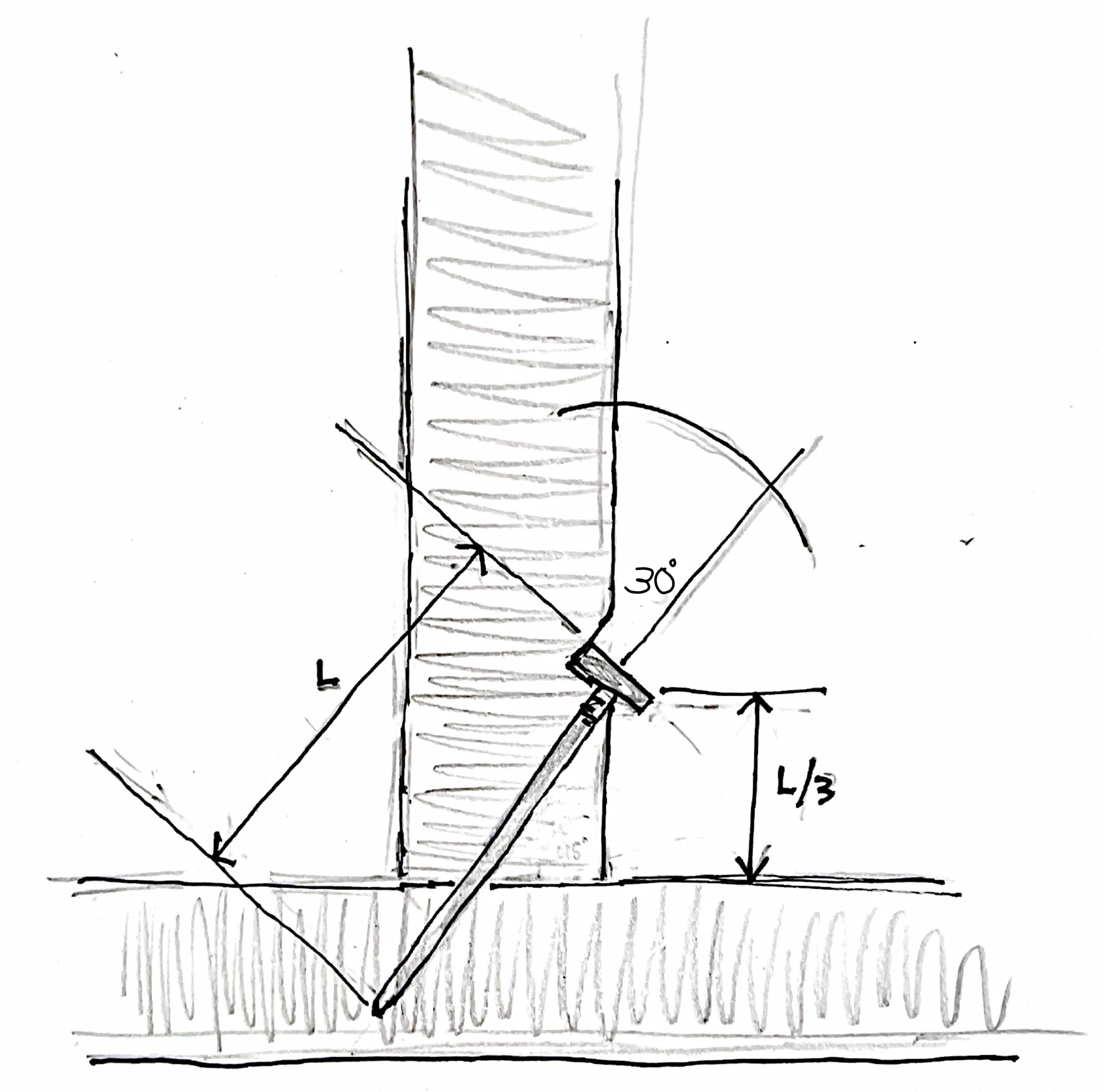
Driving a nail at an angle through the edge of one piece of wood into another creates a strong, angled connection. This technique secures wall studs to top and bottom plates, attaches floor joists to beams, band joists to sill plates, and more. When toenailing, a good technique could be to position the nail away from the end of the board at a distance equal to about one-third of the nail's length and at a 30-degree angle.
Research shows that the maximum strength of toenailed joints under lateral and uplift loads is obtained by:
- using the largest nail that will not cause excessive splitting,
- allowing an end distance (distance from the end of the attached member to the point of initial nail entry) of approximately one-third the length of the nail,
- driving the nail at an angle of 30° with the attached member, and
- burying the full shank of the nail but avoiding excessive mutilation of the wood from hammer blows.
2024 IRC Requirements and Split Wood Implications
Home inspectors are not code inspectors, but they can use building standards to help communicate observations and support recommendations.
The 2024 IRC establishes specific fastening requirements that assume intact wood connections:
- 2024 IRC R602.1.1 addresses wood quality, stating that framing lumber shall be free from defects that would significantly affect structural performance. Progressive splitting around fasteners can be considered such a defect.
- 2024 IRC Section R602.3 requires specific nailing schedules for wood frame construction, with fastener sizes and spacing designed for full holding capacity. When wood splits, these engineered connections no longer meet code-intended performance levels.
- 2024 IRC Table R602.3(1) specifies minimum fastening requirements (such as 8d common nails at 6" on center for connecting the band joist to the top plate). Incorrectly installed fasteners effectively reduces the number of properly functioning ones, potentially bringing connections below minimum code requirements.
Common Problem Areas
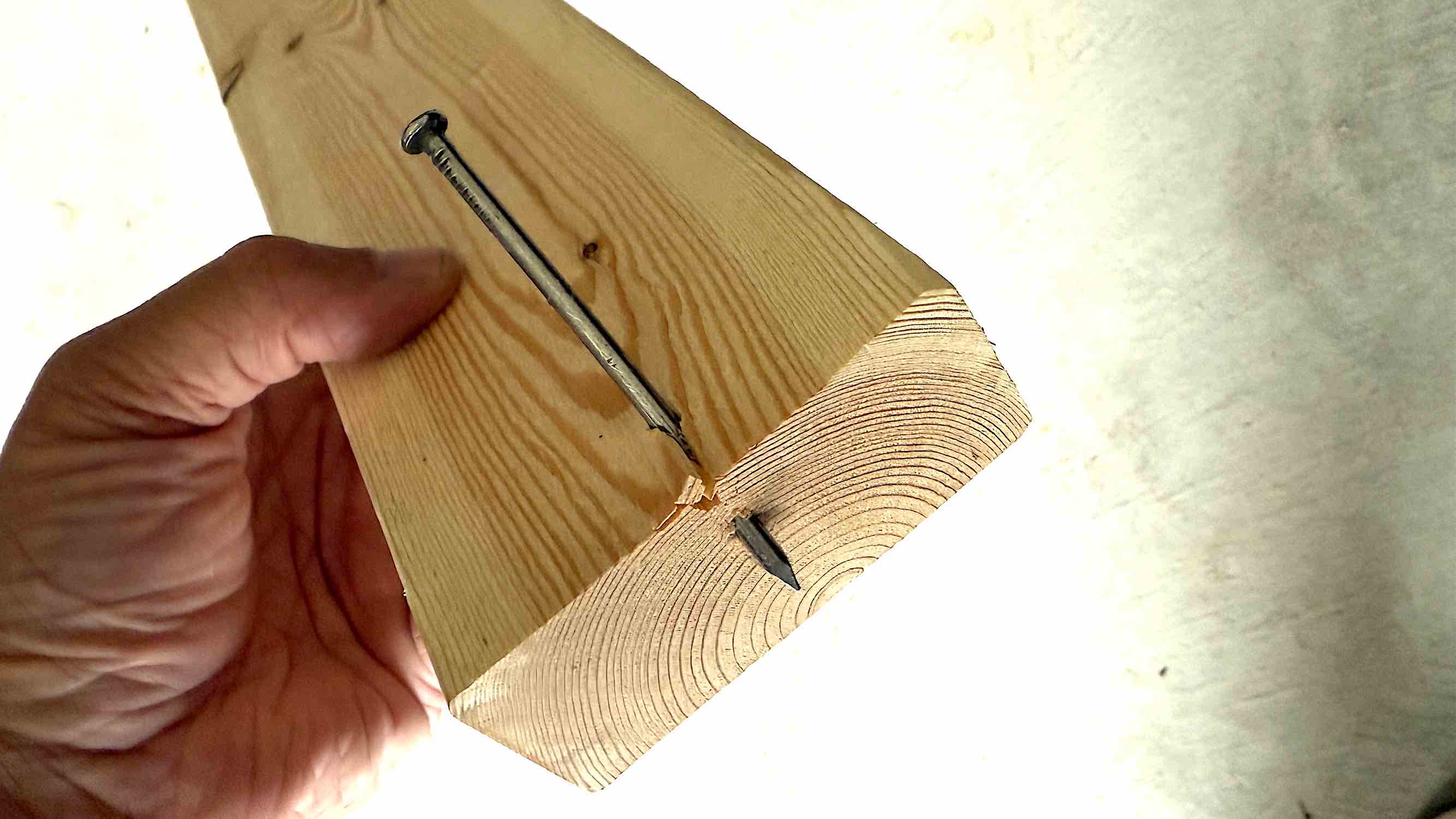
This image is of a nail splitting open the end of a 2x4.
Home inspectors could pay particular attention to nail fastener problems in several key areas:
- Toenailing connections where angled nails are especially prone to splitting the wood
- End-grain nailing which already has reduced capacity and becomes critical when splitting occurs
- Connections subject to uplift forces such as hurricane ties and rafter connections
Why This Matters for Building Code Compliance
The 2024 IRC assumes that nail connections will perform at their designed capacity. The building code's safety factors are built on the assumption that nails are properly installed in sound wood. When wood splits, these safety margins disappear, creating weak links in the structural load path from roof to foundation.
Building code requires structures to safely support all loads, and fasteners that split open wood compromise this fundamental requirement by reducing connection capacity below design assumptions. Refer to 2024 IRC Section R301.1.
InterNACHI® Pre-Drywall Inspection Training

InterNACHI's free online Pre-Drywall Inspector Course teaches home inspectors how to evaluate fastener adequacy as part of the structural assessment. This includes identifying:
- Insufficient fastener size or quantity
- Improper fastener placement
- Fasteners compromised by splitting or other damage
- Missing fasteners in critical connections
- Correct toenailing
The training explains how toenailing can provide adequate strength when properly executed, requires skill in application, and is particularly susceptible to splitting wood framing when done incorrectly.
Conclusion
Recognizing nail fasteners in split wood isn't just about following inspection protocols—it's about understanding the real science behind why these connections fail and how they relate to structural requirements in the building code. Research shows that split wood at fastening locations is a legitimate structural concern that may require further evaluation and appropriate remediation.
More
- For more inspection articles, visit nachi.org/articles.
- To take a free online training course, visit nachi.org/education.
- Become a Certified Pre-Drywall Inspector by visiting nachi.org/certified-pre-drywall-inspector.
Bibliography
- International Code Council. (2023). 2024 International Residential Code for One- and Two-Family Dwellings. Country Club Hills, IL: International Code Council.
- Forest Products Laboratory. (1965). Strength of Wood Joints Made with Nails, Staples, or Screws (Research Note FPL-0100). U.S. Department of Agriculture, Forest Service.
- Forest Products Laboratory. (1965). Nail-Withdrawal Resistance of American Woods (Research Note FPL-093). U.S. Department of Agriculture, Forest Service.
- Rammer, D.R., & Zelinka, S.L. (2004). Review of End Grain Nail Withdrawal Research (General Technical Report FPL-GTR-151). U.S. Department of Agriculture, Forest Service, Forest Products Laboratory.
- Takanashi, R., Sawata, K., Sasaki, Y., et al. (2017). Withdrawal strength of nailed joints with decay degradation of wood and nail corrosion. Journal of Wood Science, 63, 192-198.
- Yermán, L., Parra, C., Prado, M., et al. (2021). Effect of repeated wetting and drying on withdrawal capacity and corrosion of nails in treated and untreated timber. Construction and Building Materials, 289, 123-134.
- Wang, S., Wang, F., Ma, P., et al. (2024). Eco-friendly wooden nails: Bonding mechanisms and withdrawal resistance in sustainable timber connections. Journal of Cleaner Production, 478, 143-156.
- Forest Products Laboratory. (2010). Wood handbook: Wood as an engineering material (General Technical Report FPL-GTR-190). U.S. Department of Agriculture, Forest Service. fpl.fs.usda.gov/documnts/fplgtr/fpl_gtr190.pdf
- International Association of Certified Home Inspectors. (n.d.). Home inspectors evaluating problems with fasteners. Retrieved from nachi.org/home-inspectors-evaluating-problems-with-fasteners.
- International Association of Certified Home Inspectors. (n.d.). Toe-nailing gallery. Retrieved from nachi.org/gallery/framing-2/toe-nailing
