Roof Slope Multiplier
Understanding roof slope multipliers is essential for inspectors, architects, and roofing contractors who need to assess roofing systems and identify potential moisture intrusion risks. The roof slope multiplier is a mathematical shortcut that converts horizontal measurements into actual sloped surface area. This simple calculation can strengthen an inspection report and help communicate more effectively with clients and contractors about roofing concerns.
Shortcut
The roof slope multiplier is a shortcut number that accounts for the extra roof area created when a roof is sloped (angled) rather than flat.
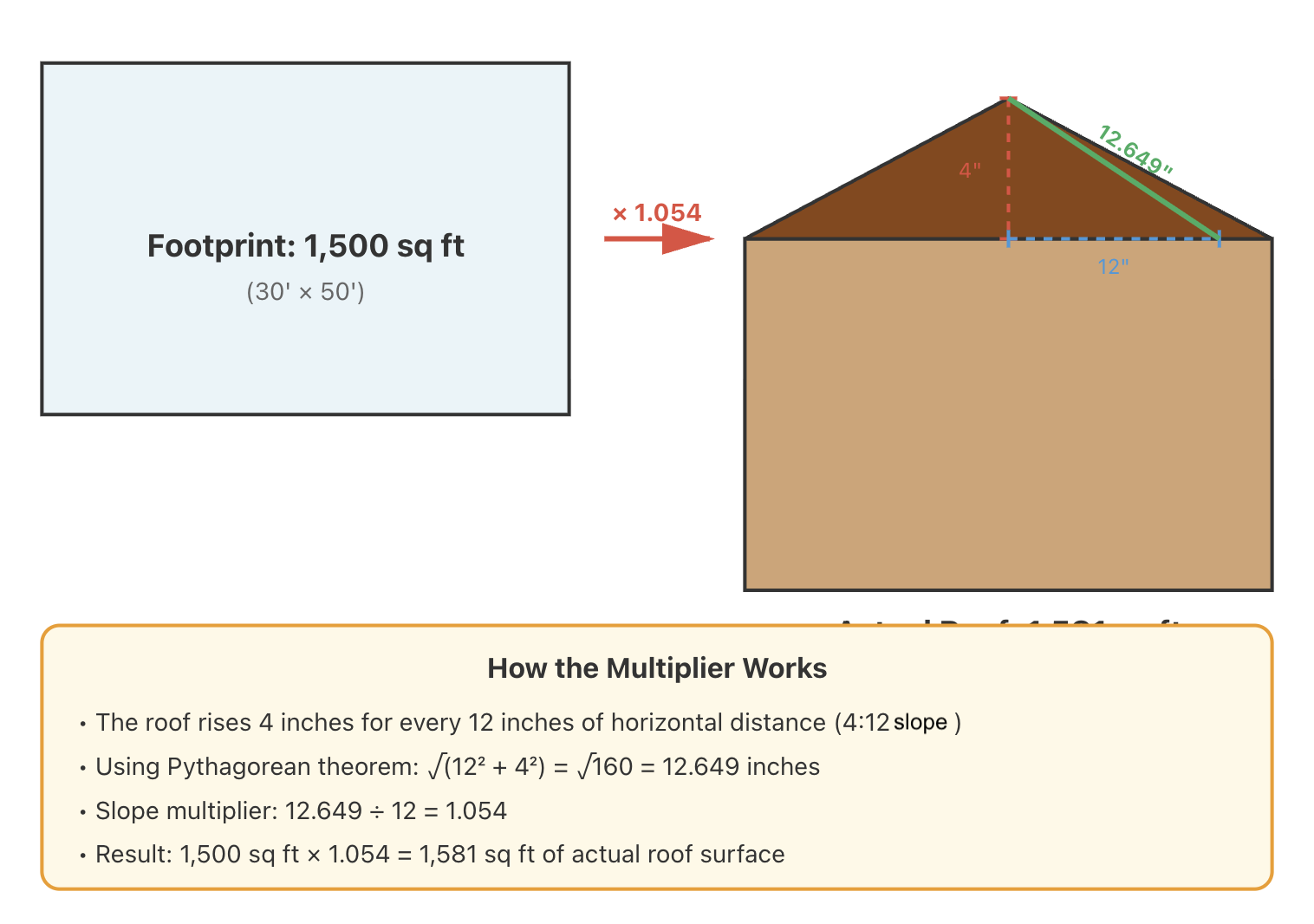
Think about it this way: if you have a 30' × 50' house, the footprint is 1,500 square feet. But when you tilt that roof up at a 4:12 slope (which means the roof rises 4 inches for every 12 inches of horizontal run), you're creating more surface area than the flat footprint below it.
The slope multiplier of 1.054 means the actual roof surface is about 5.4% larger than the footprint. So instead of just 1,500 square feet, you have 1,581 square feet of roof to cover with shingles.
Here's the Math
For a 4:12 slope, you can use the Pythagorean theorem. If you go 12 inches horizontally and rise 4 inches vertically, the actual sloped distance (hypotenuse) is:
- √(12² + 4²) = √(144 + 16) = √160 = 12.649 inches
So the multiplier is 12.649 ÷ 12 = 1.054
Common slope multipliers inspectors use:
- 3:12 slope = 1.031
- 4:12 slope = 1.054
- 5:12 slope = 1.083
- 6:12 slope = 1.118
- 8:12 slope = 1.202
- 12:12 slope = 1.414
Inspection Scenario
During your inspection, you measure a ranch home with a 40' × 60' footprint and observe a 6:12 roof pitch. Your calculation: 2,400 sq ft × 1.118 = 2,683 sq ft of actual roof surface. If the contractor's invoice lists only 25 squares (2,500 sq ft) of shingles, you've identified a potential shortage that could affect warranty coverage and long-term performance.
Accurate roof area calculations also affect net free ventilation area requirements per building code, which is critical for preventing moisture accumulation in attic spaces.
Summary
The roof slope multiplier is a practical tool that helps inspectors, architects, and contractors quickly calculate actual roof surface area by accounting for the additional area created when a roof is sloped rather than flat. Using the Pythagorean theorem, you can determine multipliers for common slopes—such as 1.054 for a 4:12 pitch—and apply them to building footprint measurements to estimate true roof coverage.
This calculation supports multiple aspects of a building inspection, including verifying contractor material claims, assessing proper installation coverage, and identifying potential moisture vulnerabilities where insufficient materials or improper calculations may compromise the roof's ability to shed water effectively. By understanding and applying slope multipliers during inspections, more accurate assessments can be provided for clients who need clear, reliable information about their roofing systems.
How To Inspect for Moisture Intrusion Course
How to Perform Roof Inspections Course
